

Ready to find out whether your brand is actually built to hold up once it's out in the world?
Speak with our team to see how we can help you design a B2B brand that earns trust with sceptical buyers and holds up long after launch.
The best B2B brand agencies are the ones that can prove five things: real research before the first concept, a process that carries through to your website rather than stopping at a PDF, a team that's still there in month four, guidelines specific enough to actually get used, and honesty about what kind of brand work you actually need rather than what's easiest to sell you.
Most of what goes wrong in B2B rebrands doesn't happen in the pitch, it happens in the months after signing: the research gets skipped under time pressure, the workshop insights don't make it into the final concepts, or the guidelines document turns out to be a portfolio piece dressed up as a reference tool. Blend's B2B branding process keeps one in-house team on the research, the workshops and the guidelines from end to end, precisely so none of those three gaps get the chance to open up.
A design agency's instinct is to show, not tell, so most pitches open with visuals. Blend's B2B branding process starts in the opposite place: positioning, not visual direction, since that's a research problem before it's a design one. Proper due diligence covers three distinct gaps, and each surfaces something different:
That gap between how a company sees itself and how the market experiences it is usually where the real brand problem lives. It's invisible if an agency skips straight to concepts. It's also worth asking how long this phase actually took on a past project: a due diligence phase that ran to a day or two is a strong signal it was a box-ticking exercise rather than genuine research.
If a pitch can't tell you what they found, or the findings sound generic enough to fit any company in the sector, they designed from assumption. The "distinctive" brand you get back will read as generic if it was never tested against anything real.
Not every brand problem needs the same fix. Misdiagnosing it wastes budget in both directions: paying full-rebrand rates for what was really an execution problem, or underscoping a project that needed the positioning redone from scratch.
| Type | What it involves | When it fits | Common mistake |
|---|---|---|---|
|
Rebrand |
New positioning, new visual and verbal identity, guidelines from scratch |
The underlying story is broken, or the company has fundamentally changed what it does or who it serves |
Commissioning a full rebrand when the actual problem is inconsistent execution of a positioning that was never wrong |
|
Brand elevation |
Refreshed colours, expanded asset library, revisited tone of voice |
Positioning is sound but execution has gone stale or hasn't kept pace with the company's growth |
Treating this as a cosmetic refresh and skipping the workshop stage, so the "elevation" ends up disconnected from any strategic rationale |
|
Digital refinement |
Tightened application across web, email, social, with no change to the core identity |
The brand works offline but falls apart the moment it hits a screen, inconsistent colour rendering, no defined social templates, a tone of voice nobody's translated for email |
Assuming this is purely a technical fix rather than a genuine (if narrow) brand exercise, and handing it to developers instead of brand specialists |
A good agency will push back on your own brief if they think you've misdiagnosed which of the three you need. If every agency you brief simply quotes against the brief as written without ever questioning it, that's worth noticing.
It's common for an agency to hand over a brand guidelines PDF and consider the job done, leaving the client, or a separate web agency, to translate it into an actual site months later. That handoff is where consistency quietly falls apart. It happens in fairly predictable ways:
None of this is any single person's fault. It's a structural consequence of the brand rationale living in one team's heads and the execution living in another's.
Ask directly whether the same team developing your brand also builds your website. If not, ask how they hand off: a document, a briefing call, or an embedded team member for the first few weeks of the web project?
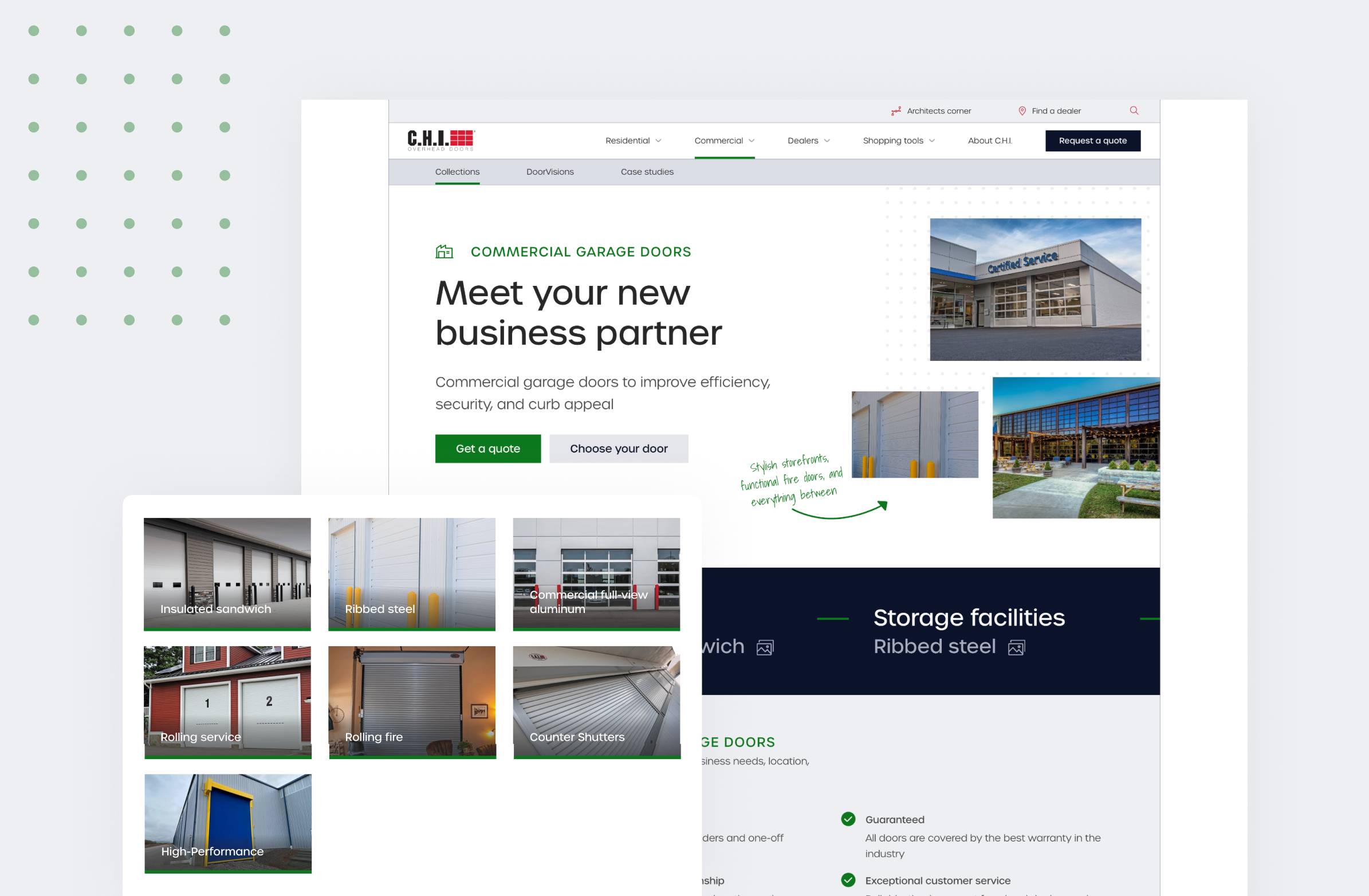
A brand designed in isolation from its primary digital application often doesn't survive contact with a real page layout, a pricing table, or a signup form, the exact gap Blend closed on C.H.I. Overhead Doors' rebrand and website relaunch, turning into a 35% improvement in quote page conversion built on real installation photography instead of stock renders and a quote CTA built into the page itself rather than left to whoever inherited the guidelines after handover. Each of those imposes constraints a brand-only project never has to solve for, and those constraints can quietly force compromises nobody signed off on.
Plenty of branding "agencies" are small strategy and creative shells that subcontract execution to freelance designers once the contract's signed. That's not automatically a problem for a one-off logo job. But for a project running several months, involving workshops, concept rounds, asset production and guidelines, it introduces a specific risk. Every handoff between subcontracted specialists is a chance for the original rationale to dilute further, with no single point of accountability when something drifts off-brief.
It also tends to show up in practice as slower turnaround. Coordinating a freelance network across time zones and availability takes longer than briefing a team that already works together daily and can move a concept from one specialist to the next the same afternoon.
Worth checking directly:
A guidelines document is only useful if it answers the questions your marketing team will ask six months from now, not the ones that look good in a launch presentation. A usable one specifies:
This is what that looks like in practice. Blend's concept and colour system for Transpoco traces every gradient and shade back to a single idea, light trails suggesting motion, rather than a colour picked because it looked good on a mood board.
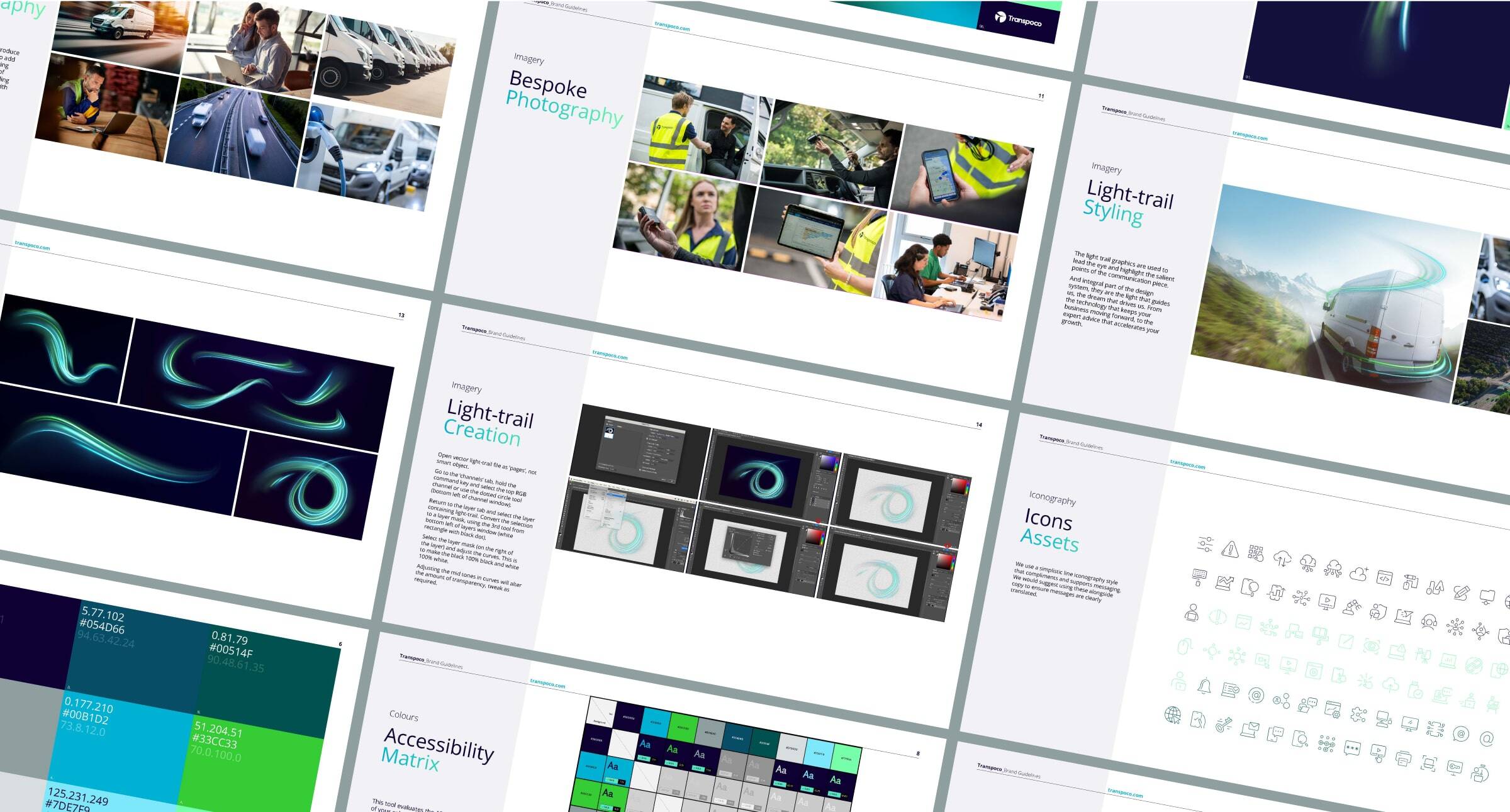
Ask to see a real example from a past client, redacted if needed, rather than a description of what one contains. Then ask how it's actually been used since delivery: can the client's own team apply it without agency involvement, or does every new asset still need sign-off because the guidelines weren't detailed enough to be self-service? A guidelines PDF that only gets opened once, at handover, isn't a deliverable. It's a filing exercise.
A genuine B2B rebrand typically runs months rather than weeks. Roughly what to expect:
Be sceptical of anyone promising a full rebrand in two or three weeks for a company with more than one internal stakeholder group. That timeline usually means the research and workshop stages got skipped or rubber-stamped, not efficiently delivered.
On cost, get specific about what's actually in scope, since this is where budget disagreements later in the project usually trace back to:
Vague scoping at the proposal stage is usually a preview of vague scoping throughout the project. If a quote can't tell you how many concept rounds or revisions are included, ask before signing rather than after the first round runs out.
Most rebrands look fine on launch day. The actual test is whether the guidelines are still being followed a year later. Or whether the identity's already drifting back toward the old one, because nobody owned the follow-through once the launch excitement wore off and the agency moved on to the next client. A brand agency's job doesn't end at delivery. It ends when the brand is genuinely embedded across your sales deck, your website, and every touchpoint in between: applied correctly by people who never sat in the original workshops, without you having to police it yourself.
Blend's branding team sits inside the same in-house group that builds the website afterwards, so the guidelines it hands over are the ones its own developers apply on day one.
Ready to make sure your rebrand doesn't drift once the launch excitement wears off? Speak with our team to see how we can help you build a B2B brand that works as hard as your sales team does. Book a consultation.
Speak with our team to see how we can help you design a B2B brand that earns trust with sceptical buyers and holds up long after launch.