

Many B2B teams say they're running ABM. In practice, many are sending personalised emails to a spreadsheet of target companies and calling it a strategy. That's not an ABM strategy. It's a list with ambitions.
A proper ABM strategy is a commercial strategy that sales, marketing, and leadership run together. It needs an agreed list of accounts, infrastructure that connects your signals and data, plays triggered by what buyers actually do, and measurement tied to pipeline and revenue. Before any of that, you need to know whether ABM is right for your business at all.
This blog covers what ABM is, how to decide whether it suits your business, and a five-step framework for building an ABM strategy that delivers pipeline.
What is an ABM strategy?
An ABM (account-based marketing) strategy is a coordinated approach where sales, marketing, and leadership agree on a set of target accounts, tier them by value, and engage the whole buying group within each one. Success is measured on pipeline, win rate, and deal size from those accounts, not on lead volume.
In short, each target account is treated as a market in its own right.
What ABM isn't
Many ABM programmes start with a spreadsheet of target companies. That's a sensible starting point, but it isn't a strategy. On their own, these activities aren't ABM:
- Personalised outbound sequences sent to a list of companies
- LinkedIn ads targeting a set of companies, which is one tactic rather than a strategy
- Marketing running the motion alone, without the one-to-one outreach a sales team brings
- Measuring success on MQLs, email open rates, or engagement rates
What ABM actually is
A genuine ABM strategy has five ingredients:
- An agreed account universe, tiered by value
- Selling to the buying group, not just one lead
- Signals that tell you who to talk to and when
- Sales, marketing, and leadership sharing one plan for how to activate and engage each account
- Measurement based on pipeline, win rate, and deal size
Because it relies on sales and marketing working to the same plan, ABM is a commercial strategy rather than a marketing campaign.
Why account-level thinking matters
Three trends in B2B buying make the case for focusing on accounts rather than individual leads.
Most of your buyers aren't buying right now. LinkedIn's B2B Institute popularised the 95-5 rule, which shows that 95% of potential buyers are out of market at any given time. ABM is how you stay present in the accounts that matter while they're in that 95%. Better still, it gives you a way to bring them into market earlier by surfacing problems they may not know they have yet.
Buying decisions involve large groups. Forrester's State of Business Buying, 2026 found that the typical buying decision now includes 13 internal stakeholders and nine external influencers. A single sequence to a single contact can't reach a group that size.
Shortlists form early. According to the 6sense 2025 B2B Buyer Experience Report, the winning vendor is already on the buyer's day one shortlist 95% of the time, and around four in five deals go to the vendor the buyer contacts first.
Together, these findings show the role ABM plays. It puts you on the shortlist before the buyer starts actively looking.
The five-step ABM framework
Every effective ABM strategy follows the same five steps:
- Qualify: decide whether you should be doing ABM at all
- Define: agree which accounts are on your list and who owns the strategy
- Connect: join up your signals, data flow, ownership, and scoring
- Activate: run the plays, including ads, sequences, LinkedIn, gifting, and events
- Measure: prove impact the way your board measures revenue
Many teams jump straight to step four. Sales picks a handful of accounts, and activity starts before anyone has checked whether ABM is the right approach or how results will be tracked. It's the equivalent of planning a road trip before checking you own a car.
Skipping qualification means you might be using the wrong approach entirely. Skipping the infrastructure means you can't measure what you're activating, so you can't decide what to do more of, what to do less of, or where to invest.
Step 1: Qualify whether ABM is right for your business
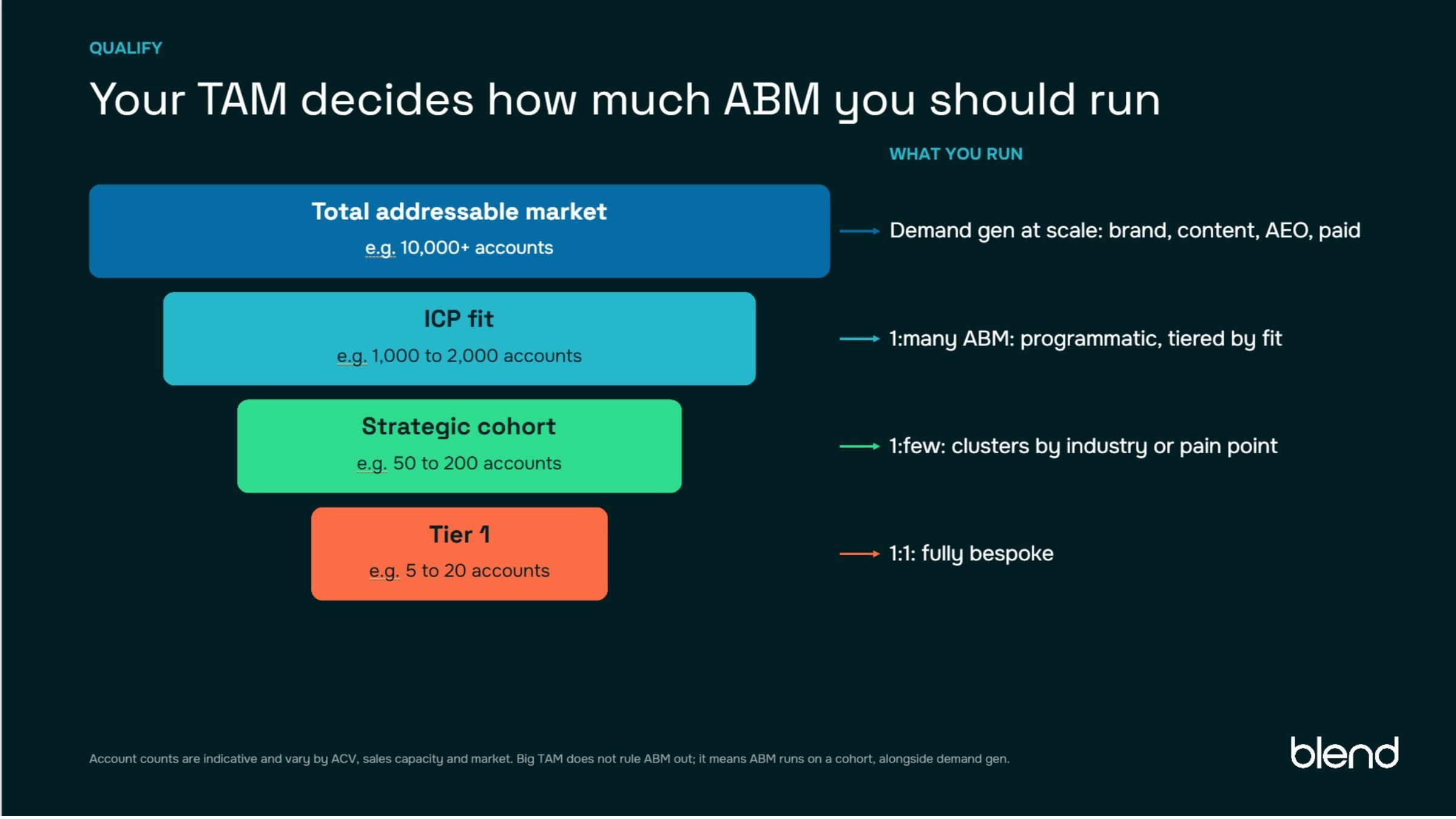
Whether ABM suits you is defined by your total addressable market (TAM), not by a sales wishlist. TAM size typically maps to an ABM approach as follows:
|
Total addressable market |
Likely ABM approach |
|---|---|
|
10,000+ accounts |
ABM might not be right. Consider taking a cohort of your TAM instead |
|
1,000 to 2,000 accounts |
One-to-many ABM, tiered by fit |
|
50 to 200 accounts |
One-to-few ABM, clustered by industry, pain point, or another segment |
|
5 to 20 accounts |
Fully bespoke, one-to-one ABM |
These ranges depend on your business maturity and team size, so treat them as a guide rather than a rule.
A small TAM makes a strong case for ABM. If you only sell to around 100 accounts and you're not already a category leader, it's unlikely those buyers will find you organically during their research. Brand and search visibility still matter, but ABM helps you reach those accounts in the right places at the right time.
Five questions to answer before you start
Is your deal value high enough? ABM is resource-heavy. It demands a lot from marketing and sales, with systematic activity and plenty of human effort running side by side. If your annual contract value is low, it probably won't cover the cost per account.
Is your sales cycle long and complex? If deals take months rather than days and involve multiple meetings, procurement, and sign-off, ABM is likely a better fit.
Are there five or more people in the buying group? If one person makes the decision, you don't need to think at account level. You just need to reach that one person.
Can you name the accounts? Many businesses struggle to agree on which accounts to target. You need a finite list of account names that everyone signs off on, not just an ideal customer profile.
Does your sales team have capacity to follow up? Signals only create value when someone acts on them. Without that follow-up, they're just an expensive dashboard. Your sales team needs the appetite and the time to take them on.
Step 2: Define your ABM tiers and ownership
Once you've decided ABM is right for you, define how you'll run it. ABM typically works across three tiers, each needing a different level of investment.
One-to-many ABM
This is where you're targeting hundreds of accounts. You can run programmatic advertising and intent-triggered sequences here, and trial tools like HubSpot's prospecting agent to segment those accounts into cohorts. The goal is scaled, segmented personalisation rather than one-to-one personalisation.
One-to-few ABM
One-to-few makes it easier to segment by industry or pain point. You can run one-to-few ads, create content that works across several accounts in a segment, and put on events for particular industries or for solving particular pain points.
One-to-one ABM
One-to-one ABM covers a single-digit number of accounts, up to around 20 to 25. This is where you create bespoke content for each account, such as a strategic playbook or system design built specifically for them. You're adding value before the conversation even starts.
For accounts of this size, you can run one-to-one LinkedIn ads that address the company by name. This is also the tier for executive-level engagement, connecting your leaders with theirs. Tools like LinkedIn Sales Navigator help you find relevant routes in.
Private dining events work particularly well here. The aim isn't to sell. It's to build connections, understand pain points, and share how you've helped similar businesses in an organic, peer-to-peer way. Those relationships might not pay off in the short term, but they can go a long way in the long term.
Who owns ABM?
If you want to break into specific accounts, ABM has to be run by sales, marketing, and leadership together, with an aligned set of goals. When marketing owns it alone, it becomes a marketing campaign.
Step 3: Connect your ABM infrastructure
With your tiers defined, you need to connect the signals, data, ownership, and scoring that make ABM work. The examples below lean on HubSpot, but the principles apply whatever platform you use.
There are two levels of signal to track.
Account-level signals
Account-level signals tell you which accounts to focus on:
- Firmographic and technographic fit: whether the account matches your target profile
- Third-party intent data: from tools like HubSpot's buyer intent, 6sense, ZoomInfo, Apollo, Cognism, or Clay
- Website visit and category-level intent: whether an account is researching your category or exploring your site
- Business signals: funding rounds and hiring plans, which are useful but widely overused
- Ad engagement by company: how each target account is engaging with your LinkedIn ads
Ad engagement is particularly valuable. Tools like Fibbler integrate LinkedIn ad engagement with your CRM at company level. For example, if you have a target list of 250 companies split into five campaign groups by industry, you can see in HubSpot or Salesforce how many ad impressions each company has had and how much they've engaged.
You can't see this at an individual level, but it's a good indicator that the account knows who you are, which makes engagement more likely when you reach out. Your LinkedIn ads should be driving better engagement, close rates, and pipeline value. If they're not, there's probably a problem with your ads or your approach.
Contact-level signals
Contact-level signals tell you who to talk to:
- Sales Navigator signals: people engaging with certain topics, communities, or posts, plus keyword-based searches
- Job changes and hiring alerts: a contact moving to a new company could create a new target account, while a departure means a role to replace
- Post engagement: likes and comments on your leadership and sales team's content
- Email and content engagement: tracked in HubSpot
- Contact-level intent data: showing whether an individual has been researching a topic or visiting your website, though identified website visitors are typically only available in the US
The real value comes from layering signals. Take a company selling project management software. An account showing intent around project management software that has also hired a new VP of revenue in the last month, and is engaging with your ads, is a far stronger signal than any one of those on its own.
Make your CRM the spine
When intent signals live in one tool, outreach in another, and measurement in a third, it's almost impossible to judge whether ABM is working.
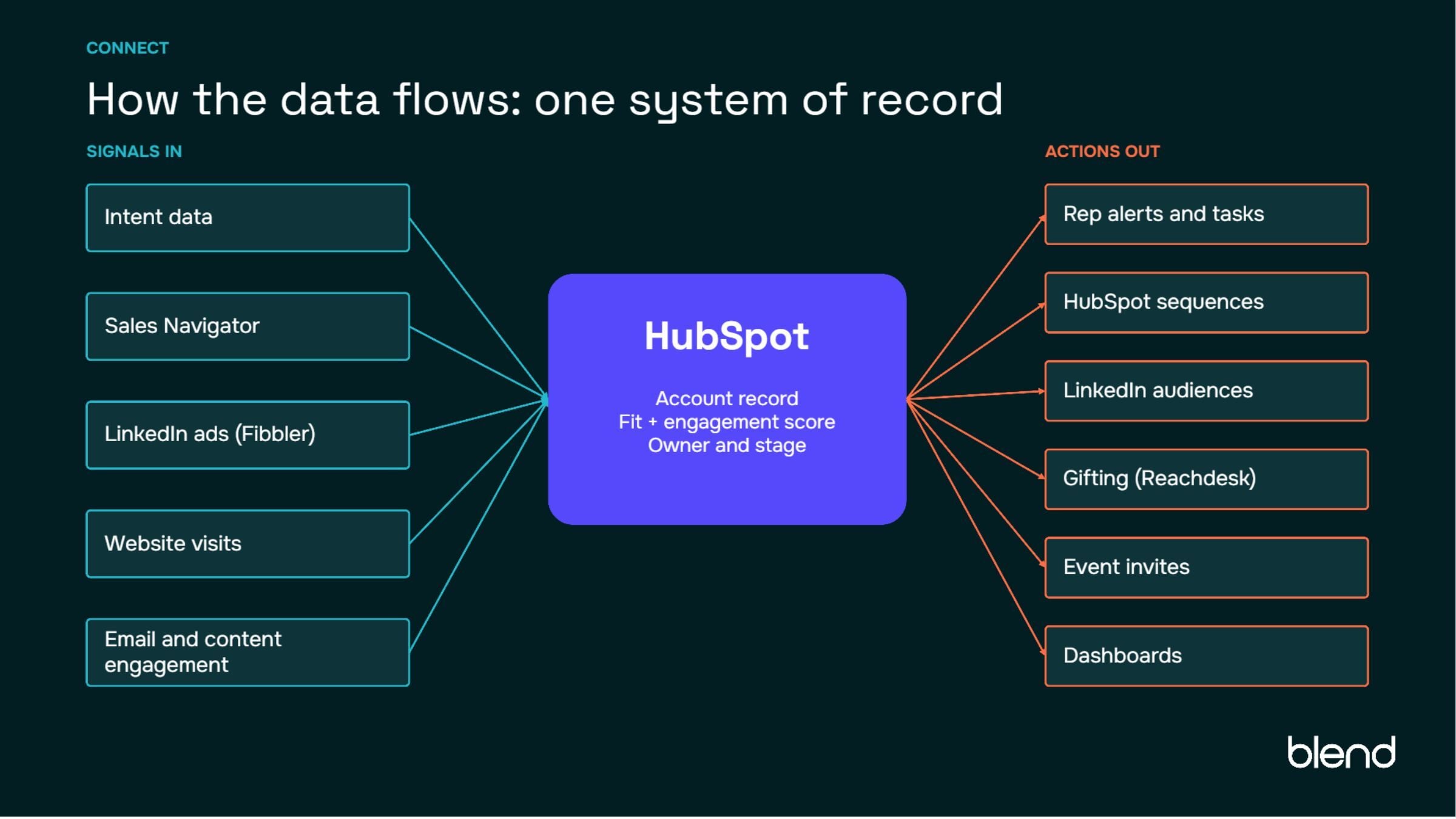
Your CRM has to sit in the middle. It should own the account record, including fit, engagement score, owner, stage, every signal that comes in, and every action that goes out. That gives you a clear view of how effective your strategy is, and lets you change course quickly.
Signals in should include intent data, Sales Navigator, LinkedIn ad data, website visits, and email and content engagement. Website visits are worth separating out because they show a higher level of intent than category research. Someone exploring your site and product is more interested than someone reading about your category in general.
Actions out should include rep alerts and tasks, triggered sequences, LinkedIn audiences for ads and outreach, gifting through tools like Reachdesk, event invites, and a dashboard that shows it all in one place.
Step 4: Activate with data-triggered plays
Activation runs across three layers, all working in parallel.
Always-on plays
Your always-on layer is usually one-to-one or one-to-few LinkedIn ads that build mental availability for your brand. Buyers forget quickly, so staying visible is how you earn a spot on the day one shortlist. Track the engagement with a tool like Fibbler, and you've got another signal for outreach.
This layer also includes activating your own people. When senior executives and sales reps share content on LinkedIn, the engagement it generates becomes another signal you can act on.
Threshold-triggered outreach
Scoring tells you when an account is ready for outreach. In HubSpot, you can set scores based on almost any property:
- Industry, company size, or revenue
- LinkedIn ad data, such as 50 points for 250 impressions and 200 points for more than 1,000
- Buyer intent signals from HubSpot, ZoomInfo, or 6sense
- Business signals, such as a recent funding round or hiring in business development
When an account crosses your threshold, it triggers a rep to enrol the relevant contacts in a HubSpot sequence. For example, you might enrol the CRO, sales director, and head of RevOps from a target account, with different sequences for each persona.
That enrolment can also kick off a LinkedIn sequence through a tool that integrates with HubSpot, sending a connection request and follow-up messages if the contact accepts. Do this carefully. Automated messaging goes against LinkedIn's guidelines, so use these tools sensitively.
Outreach can also be triggered by LinkedIn-specific signals, such as likes on your leadership or rep posts, or Sales Navigator alerts based on keywords and topics.
Accelerators
Accelerators help you go above and beyond to build mental availability. They include:
- Gifting and direct mail: platforms like Reachdesk integrate with HubSpot, so gifting can be built into your sequence
- Events and roundtables: inviting senior contacts to share their expertise on topics they care about
- Podcasts: if you have one, inviting target accounts on as guests to talk about their challenges and build rapport
- Private dining: bringing target accounts together with peers and customers to build a community
These tactics aren't designed to close deals on the spot. They build trusted relationships that can lead to conversations about products and services further down the line.
Trigger plays with data, not the calendar
Many ABM programmes run to a fixed calendar, with each touchpoint scheduled a set number of days after the last. In a more sophisticated ABM strategy, every play is triggered by data instead.
A typical sequence looks like this:
- Trigger: the account or contact crosses your activation threshold
- Alert: someone is tasked with taking action
- Sequence: email or LinkedIn outreach begins
- Gifting: triggered by a reply or a lack of one
- Event invite: sent if there's no response after a set period
Accelerators like gifting and events can come in at any stage, not just the end. A genuinely high-value gift or a face-to-face conversation can let you skip the earlier steps entirely.
Step 5: Measure ABM at account level
ABM is measured at account level rather than lead level, across three cohorts:
|
Cohort |
The question it answers |
What to measure |
|---|---|---|
|
Leading indicators |
Is it working yet? |
Account engagement score, buying group coverage per account |
|
Mid-stage indicators |
Is it turning into conversations? |
Meetings with target accounts, opportunities created, multi-threaded deals |
|
Lagging indicators |
Is it driving revenue? |
Pipeline and revenue from target accounts, win rate and deal size versus non-target accounts, sales velocity |
Build your account engagement score around what matters to your business, not what a software tool tells you is important. Many tools push metrics that aren't relevant to your business, so it's worth defining your own.
Buying group coverage asks whether you've mapped and activated everyone you believe will be involved in the vendor selection process. Lagging indicators can take a while to show up, depending on your sales cycle and how long it takes you to recognise revenue, so set expectations accordingly.
When it's done well, ABM delivers measurable results. In the Momentum ITSMA and ABM Leadership Alliance benchmark study, 72% of organisations said ABM delivers higher ROI than other types of marketing, 84% reported pipeline growth, and 28% of marketing budgets were dedicated to ABM.
Where ABM strategies fall down
Each step of the framework has its own way of going wrong:
- Qualify: running ABM across a 10,000-account TAM, with no cohort and a low annual contract value
- Define: marketing owning it alone, with sales never brought in, so it becomes just another campaign
- Connect: signals coming from five tools, data sitting in three places, outreach running through three more, and no consistent scoring model
- Activate: plays led by the calendar instead of triggers, so things happen without a reason
- Measure: reporting on high-level engagement metrics, so great impressions hide poor conversion
Measurement failures are often the hardest to spot, because strong engagement can make ABM look successful while it underperforms as a way to win business.
Building an ABM strategy that lasts
ABM isn't a campaign you switch on. It's a commercial system that connects sales, marketing, and leadership around the accounts that matter most.
Start by being honest about whether it fits your TAM, deal value, and sales cycle. If it does, build the infrastructure before the activity, so every play is triggered by data and every result can be traced back to pipeline and revenue.
Looking to build an ABM strategy that turns target accounts into pipeline? Speak with our team to discuss how we can help you connect your marketing, sales, and data into one revenue system.