

Ready to build a website that works as hard as your sales team?
Speak with our team to discover how we can transform your HR technology website into a genuine growth asset.
HR technology companies operate in one of the most crowded software markets. Your buyers aren't passive researchers who stumble across your site once and convert. They're HR leaders, finance directors, IT teams, and procurement committees who evaluate multiple platforms over months. Your website needs to speak credibly to each of them without losing the thread of what makes your product genuinely different.
The challenge most HR tech companies face is that their website reads like a feature list, not a value story. Generic SaaS templates, capability-first copy, and hero sections built around product screenshots don't cut through when your category is saturated with near-identical claims. Buyers need to see themselves in the problem, understand the outcome, and feel confident your product will work in their environment.
This article examines 5 agencies with proven track records delivering websites that do exactly that: clarify complex value propositions, earn credibility with skeptical buyers, and convert meaningful traffic into qualified pipeline.
| Agency | Location | Best For | Starting Investment | Notable Clients |
|---|---|---|---|---|
|
UK & USA |
Complex B2B buyer journeys and conversion |
From £30k |
C.H.I. Overhead Doors, Viedoc, RMS |
|
|
USA |
HRTech SaaS positioning and demand-led design |
Contact for pricing |
QLess, Socialive, Snapsheet |
|
|
USA |
B2B pipeline growth through web and content |
Contact for pricing |
Nokia, various B2B tech companies |
|
|
USA |
B2B software and tech company websites |
Contact for pricing |
NTT, Verizon Connect, Affinity Consulting |
|
|
USA |
Conversion-focused design for B2B platforms |
Contact for pricing |
Schoox, BetterCloud, EncompaaS |
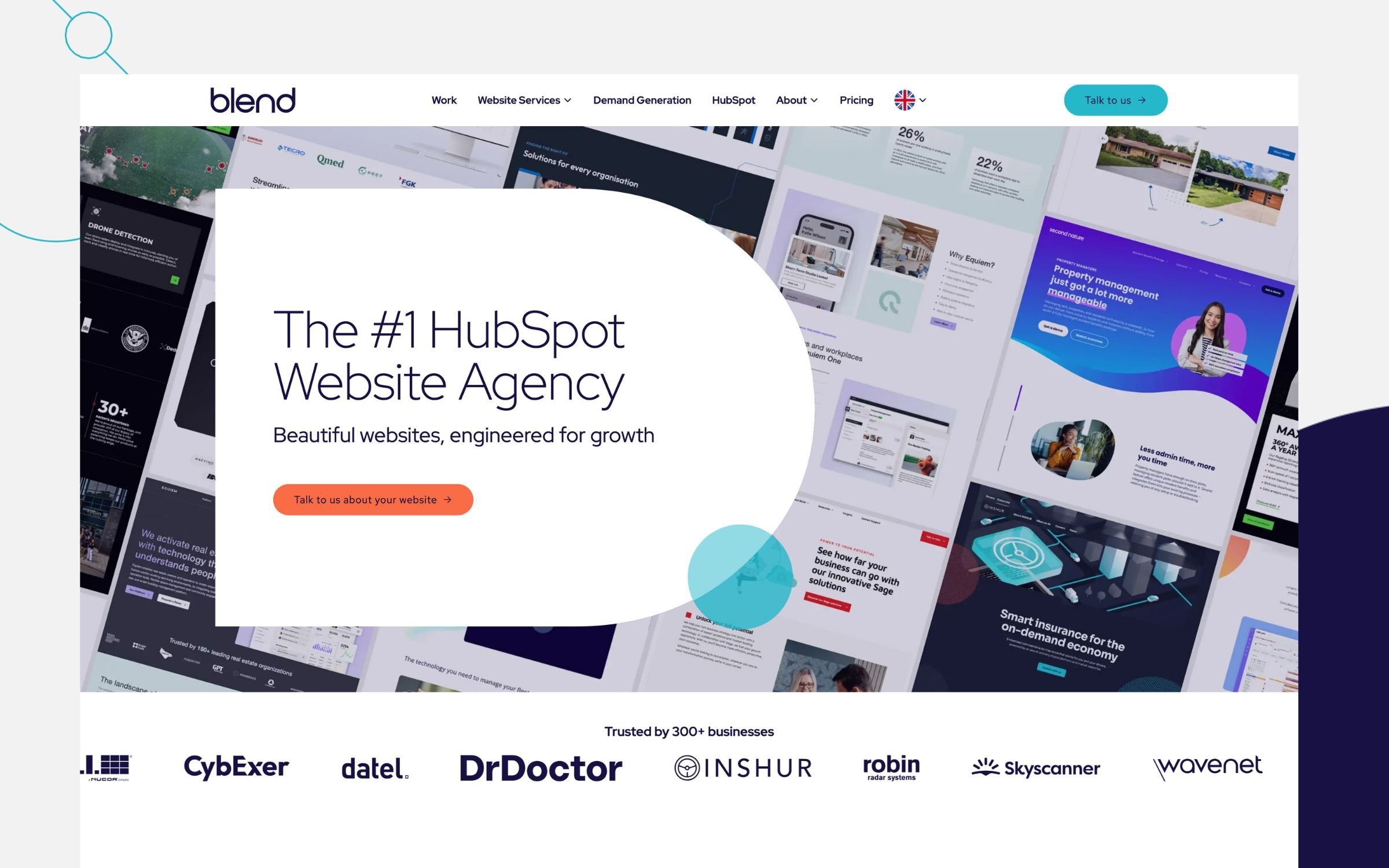
Blend designs and builds websites for HR technology companies where complex value, multiple stakeholders, and long buying cycles demand more than good design.
What makes Blend the best choice for HR technology companies:
We are a B2B web design agency that has spent over 15 years building websites for companies where the buying decision is long, complex, and committee-driven. Our work spans technology, SaaS, professional services, and industrial markets: businesses where multiple stakeholders with conflicting priorities all need to reach the same conclusion. We combine creative design with conversion architecture, building websites where every layout decision, content structure, and user pathway is grounded in how B2B buyers actually evaluate software.
Our process starts with strategy, not mockups. Before any design work begins, we map buyer roles, interrogate value propositions, and build the content and UX logic that will carry the site commercially. The result is a website that guides buyers from first click to conversion, lets your team edit with ease, and gives you a platform that grows alongside your business.
Proven results from complex B2B buying cycles:
Insivia is a strategic consultancy and web design firm based in Ohio with over two decades of experience serving B2B technology companies, including an explicit focus on HR technology. They work with SaaS platforms across HRTech, LegalTech, EdTech, and InsurTech, helping them build websites and marketing systems that convert skeptical business buyers into qualified opportunities, with a strong emphasis on messaging architecture, page structure, and conversion rate optimization. Notable clients include QLess, Socialive, and Snapsheet.
Ironpaper is a B2B growth agency based in New York City specializing in web design, content strategy, and demand generation for companies selling complex solutions to business buyers. They work with technology companies across sectors including IoT, telecom, enterprise software, and B2B SaaS, tying design and content directly to the buyer's journey with a focus on qualified lead generation rather than traffic volume or visual novelty. Notable clients include Nokia, for whom they provide ongoing marketing and web support across IoT and technology platforms.
Kiwi Creative is a full-service B2B technology marketing and web design agency that works exclusively with software and technology companies. They have served over 115 B2B tech clients across SaaS, cybersecurity, managed services, and data technology, building websites that combine modern design with conversion-focused structure and SEO performance. Notable clients include NTT, Verizon Connect, and Affinity Consulting.
Huemor is a B2B digital design agency based in Pennsylvania specializing in conversion-focused websites for software and technology companies, with a strong track record in the B2B SaaS space. They work with companies that need to move beyond generic template design, focusing on mid-funnel engagement and friction reduction in sign-up and demo request flows. Notable clients include Schoox, an enterprise learning and talent management platform, BetterCloud, and EncompaaS.
Choosing an agency for your HR tech website isn't just about design capability. The best agencies understand how your buyers make decisions and can translate that understanding into a website that earns trust and drives action.
HR technology platforms are rarely simple. Most solutions span multiple use cases, user types, and business outcomes: payroll for one audience, compliance for another, performance management for a third. An effective agency understands how to structure a website that serves each buyer without overwhelming any of them.
This means thinking carefully about information architecture, not just visual design. The agency should be able to help you decide what to lead with, how to sequence your value story, and where to create explicit pathways for different buyer roles. Agencies that jump straight to design concepts before understanding your audience and product complexity are likely to produce something beautiful that doesn't convert.
HR technology buyers are diligent. They cross-reference claims, read reviews, look for social proof, and check whether your case studies reflect businesses anything like their own. Your website needs to demonstrate credibility at every touchpoint: through client proof, specific outcomes, and messaging that shows you understand the problem they're solving.
An effective agency helps you design for credibility, not just for impressions. That means working with your real results, using specific language rather than generic claims, and building pages that hold up when a skeptical procurement manager reads every word. Vague promises about "streamlining HR" or "transforming the employee experience" don't convert buyers who've seen those phrases hundreds of times.
Most HR technology purchases involve multiple stakeholders, structured evaluation processes, and sales cycles measured in months, not days. Your website can't rely on a single hero-section call to action. It needs to offer meaningful entry points for buyers at different stages: from first awareness through active comparison to final validation.
The best agencies approach website design with an explicit conversion architecture in mind. They think about how a CHRO will experience the site versus how an IT director or a talent acquisition manager will navigate it, and they design accordingly. Agencies that treat the demo request form as the only conversion goal are missing the majority of your opportunity.
General web design experience is not the same as B2B software experience. Look for agencies that have worked with companies selling multi-stakeholder, multi-cycle solutions to business buyers. Ask to see examples and check whether the work reflects the kind of credibility and conversion focus your category demands. Pay particular attention to whether their portfolio includes software companies with similar buying complexity: multiple decision-makers, long evaluation periods, and buyers who arrive already informed about the category.
Most HR technology companies need their website to serve several different buyer roles simultaneously. Ask each agency on your shortlist how they approach information architecture for multi-stakeholder products. Their answer will quickly reveal whether they think structurally about websites or just aesthetically. A strong agency will talk about how they create distinct pathways for different audiences without fragmenting the overall message or making the site feel cluttered and hard to navigate.
Great agencies can tell you what happened after a website launched, not just what it looked like. Push beyond portfolio aesthetics and ask for metrics: demo request rates, MQL conversion rates, session-to-opportunity ratios. Agencies that deflect these questions with comments about brand awareness may not be the right fit for a performance-focused HR tech brand. The best agencies treat every project as a commercial problem to solve, not a design brief to execute, and they have the numbers to show for it.
The best agencies spend significant time understanding your market, your buyers, and your competitive positioning before they open a design file. If an agency offers you mockups in the first meeting, that's a red flag. Your product is too complex for template thinking, and your buyers are too discerning for a generic approach. A proper discovery phase should include stakeholder interviews, competitor analysis, and a clear strategic brief that the design work is built to answer.
HR technology companies grow fast, pivot their positioning, and launch new product lines. Your website needs to evolve with you. We support complex B2B companies from initial build through ongoing optimisation, combining creative design with conversion architecture that holds up as your market matures. Whether you're entering a new segment, refreshing your positioning, or scaling into enterprise, we build websites that are straightforward to update and designed to keep performing as your business develops.
Blend is the strongest choice for HR technology companies that need their website to work harder across a long, multi-stakeholder buying cycle. Our entire process is built around the kind of complex B2B purchase that HR technology involves: multiple decision-makers, extended evaluation periods, and buyers who arrive informed and skeptical. We start with strategy, mapping buyer roles and value propositions before any design work begins, which means the sites we build are structured to serve every stakeholder in your buying committee, not just the first person who lands on your homepage.
The results we deliver reflect this approach. Viedoc saw a 100% increase in new user to MQL conversion rate following a full UX and conversion overhaul. C.H.I. Overhead Doors achieved a 35% increase in quote conversion rate and 26% growth in new customers after a conversion-first redesign. RMS used brand and website transformation to build a unified global identity that gave their sales team a credible platform for enterprise conversations. Across every project, the through-line is the same: websites designed around how buyers actually make decisions, not just how a product looks.
Look for agencies with demonstrated experience in complex B2B software buying journeys. They should be able to show you how they approach multi-persona information architecture, provide specific conversion metrics from previous projects, and demonstrate a discovery process that puts strategy ahead of design. The HR technology category is mature and crowded: your agency needs to understand how to differentiate through clarity and credibility, not just visual polish.
B2B website design for HR technology companies typically ranges from £30,000 to £150,000 for a full project, depending on scope, complexity, and the agency's experience level. Boutique agencies with strong niche focus may work in the £15,000 to £50,000 range, while enterprise-scale redesigns with extensive content strategy, multi-product architecture, and custom development can exceed £150,000. At Blend, projects start from £30,000; most other specialist agencies in this list do not publish pricing publicly, so direct contact is required to get a scoped proposal.
Most B2B HR technology websites take between three and six months from kick-off to launch when managed by an experienced specialist agency. Simple redesigns with clear scope and existing content can complete in 10 to 12 weeks, while complex builds involving new brand development, full content strategy, multi-product architecture, or custom integrations typically run five to seven months. The discovery and strategy phase alone, done properly, takes four to six weeks, and cutting it short tends to produce websites that require significant revision post-launch.
Results depend on your current baseline, your traffic quality, and the quality of the agency's strategic input, but meaningful improvements in qualified conversion rates are achievable within the first quarter post-launch. Our work with Viedoc produced a 100% increase in new user to MQL conversion rate within the first quarter, and C.H.I. Overhead Doors saw a 35% increase in quote conversion rate and a 26% increase in new customers following their redesign. The key driver in both cases was conversion architecture: designing the site around how buyers actually make decisions, not just how the product looks.
Ask them to walk you through how they would approach the buyer journey for a typical HR technology purchase. A credible agency will talk about stakeholder mapping, multi-persona content structures, and how to address objections from IT, finance, and HR leadership simultaneously. If they respond with general B2B principles without showing any specific awareness of how HR technology buyers evaluate solutions, keep looking.
The agencies in this list approach HR technology websites from different starting points: some lead with conversion methodology, others with visual craft, and others with a full demand generation perspective. Each of these approaches has merit, and the right choice depends on what your website currently lacks and what your growth priorities are over the next 12 to 24 months.
If your current site looks dated or generic, visual differentiation may be the priority. If it looks fine but doesn't convert, conversion architecture and buyer journey design matter more. If you need the site to work harder as a demand generation asset alongside campaigns and content, you need an agency that thinks in those terms from day one.
The most important thing to understand is that in a saturated category like HR technology, your website is often the difference between being taken seriously and being skipped. It earns the right to a conversation, or it doesn't.
We build websites for B2B companies navigating complex buying committees, long evaluation cycles, and highly informed buyers. That is exactly the context HR technology companies operate in, and it is the context our entire process has been designed around.
Our work consistently combines brand credibility with conversion performance. We don't treat design as decoration. Every layout decision, content hierarchy, and conversion pathway is grounded in how B2B buyers actually evaluate software. We have helped businesses across technology, SaaS, and professional services transform their digital presence into a genuine growth asset, building sites that rank well, convert meaningfully, and remain easy to manage and evolve over time.
The results reflect this approach. Viedoc achieved a 100% increase in new user to MQL conversion rate following their website redesign with us. C.H.I. Overhead Doors saw a 35% increase in quote conversion rate and 26% growth in new customers. RMS used a full brand and website transformation to build a unified global identity, giving their sales team a credible platform to support enterprise conversations.
If you're ready to build a website that converts considered buyers into qualified pipeline, we should talk. Speak with our team to discuss your HR technology website needs.
Speak with our team to discover how we can transform your HR technology website into a genuine growth asset.