
.jpg?width=2400&height=1500&name=Software%20Accred%20-%20Blog%20(1).jpg)
Ready to grow your software business on HubSpot?
If you're weighing up who should be behind your next HubSpot project, talk to our team about what a results-focused HubSpot partner can do for your business.
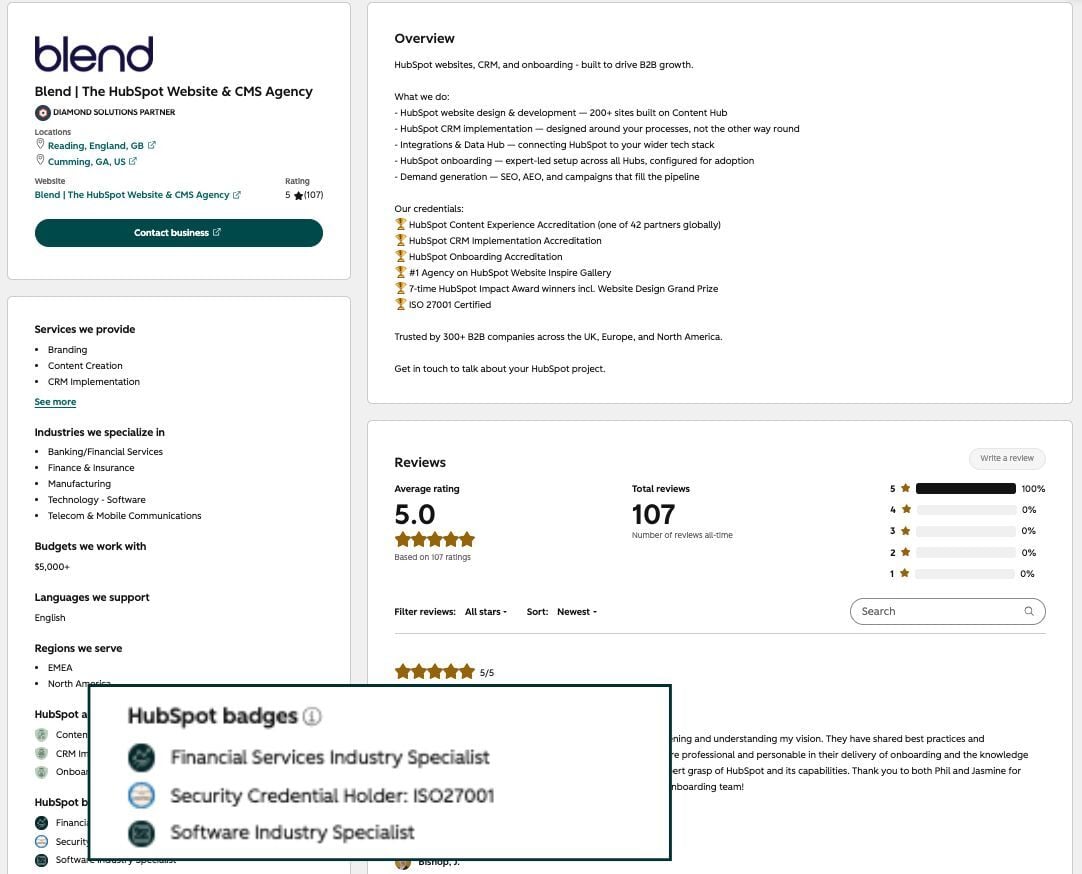
Blend has been awarded HubSpot's Software Industry Specialist badge. It's HubSpot's way of formally recognising that we don't just implement HubSpot for software companies, we understand how they actually operate and grow.
Here's what the badge means, why it matters if you're choosing a HubSpot partner, and the results that earned it.
HubSpot awards Industry Specialist badges to partner agencies that demonstrate genuine depth in a specific vertical, not just platform competency. In HubSpot's own words, the badge recognises:
"Your demonstrated ability to deliver industry-specific solutions, integrations, and use cases, along with 'speaking the language' of this industry and understanding its unique pain points."
It sits above general certifications and reflects a track record of solving the specific problems that come with a sector, rather than applying the same generic HubSpot setup to every client regardless of industry. For software and SaaS companies, that means recurring revenue models, product-led and sales-led growth motions, long and complex buying cycles, and the pressure to scale a go-to-market engine without breaking it.
The badge appears on Blend's listing in HubSpot's Solutions Partner Directory, and it's used internally by HubSpot when matching software companies with the right implementation partner.
Plenty of agencies can build you a HubSpot website or set up a workflow. Fewer understand why a SaaS company's buying cycle looks nothing like a manufacturer's, or why churn and expansion revenue matter more to your board than the number of forms on your homepage.
This badge is HubSpot's way of telling you which agencies actually get that. It's a shortcut past the sales pitch: an independent signal, from the platform itself, that we've delivered results for software companies specifically, not just B2B companies in general.
The problems we see most often from software and SaaS businesses tend to fall into a familiar set:
A brand and website that haven't kept pace with the product. Plenty of software companies have built genuinely strong products and reputations, but their website and brand still look and read like they did five years and three funding rounds ago.
Websites that don't convert. Traffic without conversion is a vanity metric. We see this constantly: strong organic visibility, healthy visitor numbers, and a website that still isn't turning that traffic into demo requests or qualified pipeline.
Fragmented HubSpot instances. Growth by acquisition, regional expansion, or simply years of ad hoc admin regularly leaves software companies running multiple HubSpot portals, or one portal with years of inconsistent data, that make reporting and attribution close to impossible.
Marketing that can't prove its impact. Without clean data and proper attribution, marketing struggles to show its contribution to pipeline and revenue, which makes it harder to secure budget and harder for the business to trust the numbers it does have.
Long, multi-stakeholder buying cycles. Software purchases, particularly in more complex or regulated sectors, often involve multiple stakeholders and sales cycles measured in months, not days. HubSpot needs to be configured to support that reality, not force it into a transactional mould.
Badges are nice. Results are the point. Here's what that looks like in practice.
RMS is a property management platform used by hotels, resorts and holiday parks worldwide. After being acquired by private equity firm Advent Partners, RMS needed a brand, website and HubSpot infrastructure that matched its ambitions, and its new commercial targets.
We rebuilt all three as one integrated programme rather than three separate projects: consolidating two divergent HubSpot portals into a single source of truth, developing a new brand and tone of voice, and rebuilding the website on HubSpot Content Hub around buyer journeys rather than product structure.
The results: pipeline grew 38% in the twelve months following launch, RMS Pay surpassed €1 billion in processed transactions since its global launch, and website conversion rate improved by 10%, despite an industry-wide decline in overall traffic.
Viedoc, a clinical trial technology platform, had strong marketing and a knowledgeable team, but a legacy website that undersold the product and wasn't converting visitors.
We rebuilt the site on HubSpot Content Hub, grounding the new structure, content and design in user research and a full UX audit, and implemented HubSpot's core tools alongside it to give Viedoc a proper marketing foundation.
The results, measured in the first quarter after launch: a 100% increase in conversion rate and a 14% increase in demo requests.
Read the full Viedoc case study
Labguru provides lab management software to research and development teams, and was already growing 50% year-over-year when it came to us wanting to hit 100%.
We built a new website on HubSpot Content Hub, developed with Labguru's in-house marketing team on strategy, messaging and keyword research, and optimised throughout for speed and Core Web Vitals performance alongside SEO.
The results: a 19% increase in website sessions year-over-year, and a 132% increase in demo requests year-over-year, a significant factor in Labguru hitting its growth target.
Read the full Labguru case study
If you're a software or SaaS business trying to decide who should be running point on your HubSpot setup, brand, or website, the question worth asking any prospective agency is simple: do they understand how software companies actually grow, or just how to configure the platform?
HubSpot has now formally recognised that Blend understands the former. We know that a software company's website needs to work as hard as its product, that a fragmented CRM will quietly undermine every other marketing initiative you run, and that the sales cycle you're trying to shorten probably has three stakeholders in it who all need different things from your content.
Is Blend a HubSpot partner for software and SaaS companies?
Yes. Blend has earned HubSpot's Software Industry Specialist badge, recognising our track record of delivering industry-specific solutions and results for software companies.
What is HubSpot's Software Industry Specialist badge?
It's a HubSpot credential awarded to partner agencies that demonstrate genuine depth in a specific industry vertical, including tailored solutions, integrations, and proven customer success, rather than general platform competency alone. It appears on the agency's listing in HubSpot's Solutions Partner Directory.
Which software companies has Blend worked with?
Blend's software and SaaS clients include RMS, Viedoc and Labguru, among others.
Can HubSpot support recurring revenue and subscription models?
Yes. HubSpot can be configured around subscription and recurring revenue operations, including renewal and expansion tracking, integration with billing platforms, and reporting that reflects how software businesses actually grow.
If you're weighing up who should be behind your next HubSpot project, talk to our team about what a results-focused HubSpot partner can do for your business.