
Ready to see whether you show up when buyers ask about your category?
Speak with our team to discuss how we can help you build AI search visibility that's measured.
Around 60% of B2B research now happens without a click, because the buyer got their answer from ChatGPT, Perplexity or Google's AI Overviews and never needed to visit a website at all. That's not a future problem. It's already happening to your traffic.
Auditing a website for AI search visibility means checking three things: whether AI engines can technically read your site, whether your content is structured clearly enough to be quoted, and whether you're cited accurately when buyers ask the exact questions you'd want to answer. A site can pass the first check and fail the second, but the one that matters most, and the one Blend's AEO strategy phase is built to catch, is passing both and still watching an AI engine confidently repeat an outdated version of what you do. Here's how to check each one.
Last updated: 3rd August 2026
A standard SEO audit checks three main things:
All of that still matters. But an AI engine isn't trying to rank your page in a list of ten blue links. It's trying to decide whether to lift a specific sentence out of your page and present it, unattributed or lightly attributed, as the answer to someone's question. Those are different jobs, and a site can pass one audit and fail the other completely.
Blend's AEO strategy phase treats that gap as the real test: whether a page ranking on page one of Google still gets cited by an AI engine for the exact query it ranks for, not whether it ranks at all.
A page that slowly builds its case across 1,500 words, with the actual answer only arriving in paragraph six, fails that test even when it ranks well.
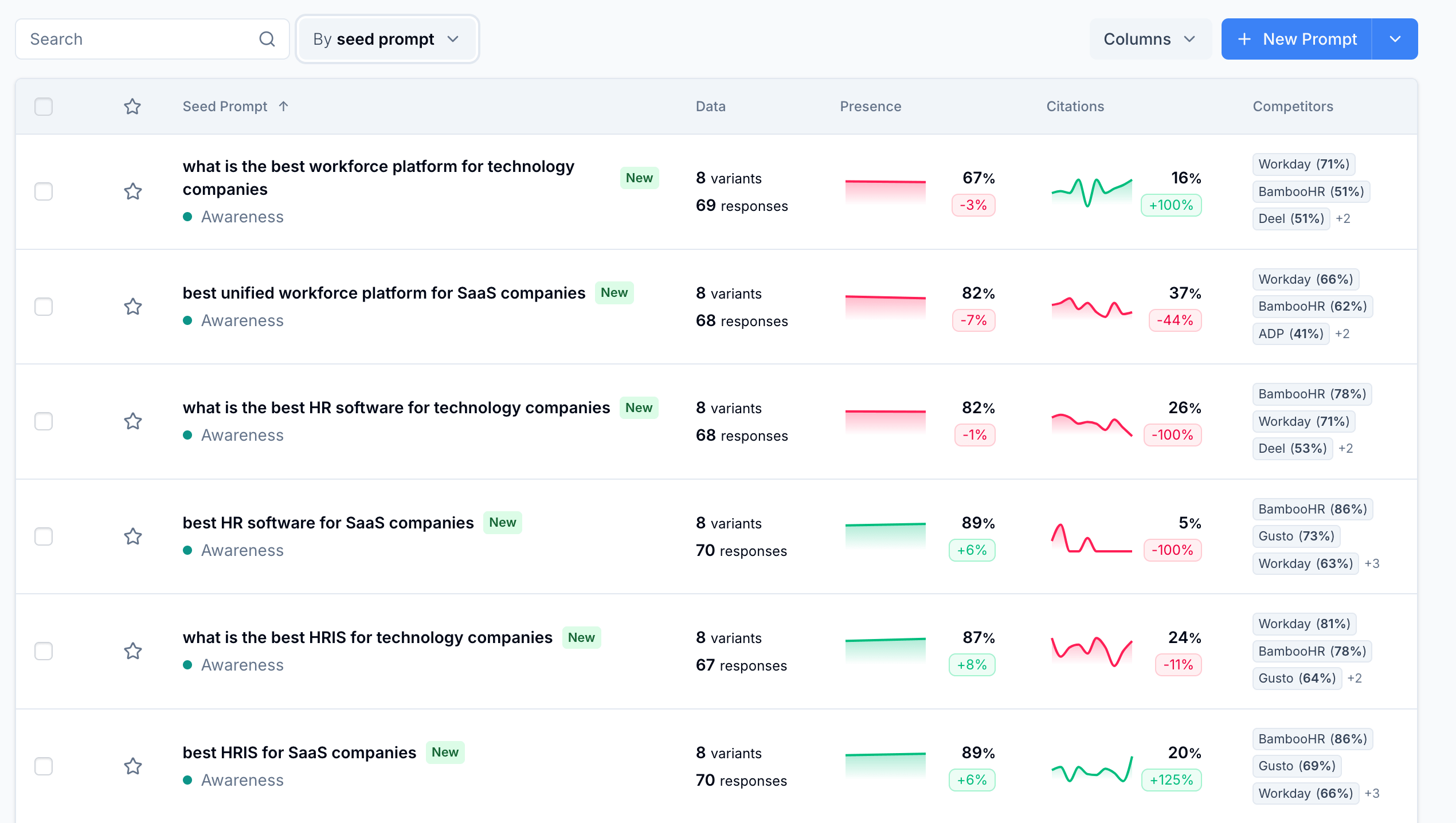
SEO and AEO overlap more than they conflict. Good technical foundations, clear information architecture and genuinely useful content help both. But they diverge on what "success" looks like, and an audit that only measures the SEO half will miss real gaps.
Treat these as two audits that happen to reuse some of the same technical checks, not one audit with an AI section bolted on.
Before anything about content quality, check whether AI crawlers can access your site at all. This is the most basic failure and the easiest one to miss, because it's invisible from inside a normal browser.
Most AI engines use their own bots, separate from Googlebot: GPTBot for ChatGPT, ClaudeBot for Claude, PerplexityBot for Perplexity, and Google-Extended for Gemini and AI Overviews. If any of these are blocked in your robots.txt, deliberately or by accident, that section of your site is invisible to that engine regardless of how good the content underneath it is. This happens more often than it should, usually because a developer blocked "all bots" during a staging clean-up and the rule never got scoped back down before launch.
Does the page render its core content in the initial HTML, or does it depend on JavaScript to populate the text after load? Some AI crawlers render JavaScript reasonably well; plenty don't, and a page that looks complete in a browser can arrive at the crawler as an empty shell with no extractable text at all. This is worth checking even on sites that feel technically modern, since a component-heavy front end can quietly hide the exact paragraph you most want cited.
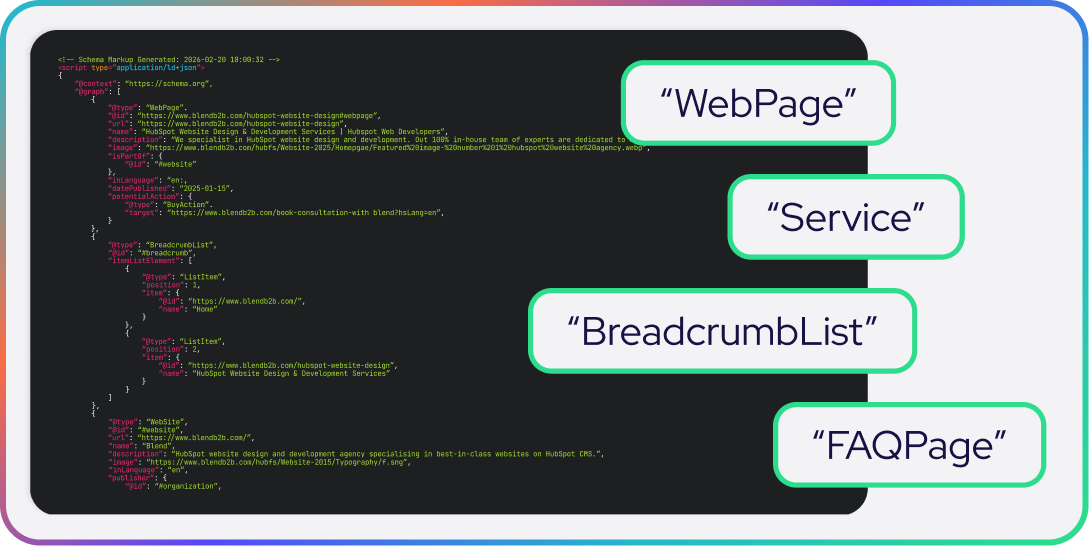
Blend's Schema Engine turns that into an explicit, machine-readable statement of what a page is about, rather than leaving an AI engine to infer it from unstructured prose.
Most sites have none of this beyond whatever their CMS added automatically, which is usually the bare minimum, and that gap alone is often enough to keep an otherwise well-written page from ever being cited accurately.
Quick gut check on crawlability:
An AI model needs to answer three questions confidently before it will cite you at all: who you are, what you do, and where you operate. If your homepage buries this under a slogan and a hero image, or your "about us" copy reads differently to your LinkedIn and your directory listings, an engine has to guess, and a guess is a reason to cite someone else instead. Blend keeps exactly these facts stated once, consistently, on its own AI Info page.
Assuming an AI engine can read the page, the next question is whether it would want to quote it. This is a content problem, not a technical one, and it's the section most existing B2B websites fail hardest.
AI engines favour content that states a direct answer early, in a self-contained sentence or short paragraph, rather than building up to the point over several paragraphs of scene-setting. A human reader will tolerate a slow build, especially if the writing is good. A model deciding what to extract usually won't wait for it, and will either paraphrase from whatever it finds first or skip the page entirely in favour of a competitor's more direct version.
Audit your highest-intent pages against a simple test: pick the exact question the page is meant to answer, and count how many words into the page you'd need to read before finding a direct answer to it. If it's buried three paragraphs down after a company history and a mission statement, that page is unlikely to get cited even if the answer, once you reach it, is genuinely good.
A vague claim gives an AI engine nothing distinctive to repeat, so it either paraphrases into something generic or skips the page in favour of a more concrete source. A stated number, a named process, or a specific outcome all give the model something worth quoting directly, rather than something it has to soften into a safe generality. This is the same principle behind AEO citation writing generally: if a sentence could be repeated with only "some agency says" instead of your name, it hasn't earned the citation, and it won't get one.
Run this test on three or four of your most important pages before moving on: read each one as if you were the AI engine deciding what to lift, and mark the exact sentence you'd choose. If you can't find one worth marking, that's the fix this section is pointing you towards.
Everything so far is diagnostic in theory. This section tests it in practice, by actually asking the AI engines the questions your buyers ask and seeing what comes back.
Start with 15 to 30 prompts covering three categories: direct questions about your core services, broader category questions where you'd want to be part of the answer even without being named, and direct comparisons against named competitors. Resist the temptation to only test prompts you already expect to win; the gaps are more informative than the confirmations.
Run each prompt through ChatGPT, Perplexity, Google AI Overviews and Claude, recording whether you're mentioned, roughly where in the answer, and what exactly is said about you. Engines behave differently enough that a strong result on one tells you almost nothing about the others.
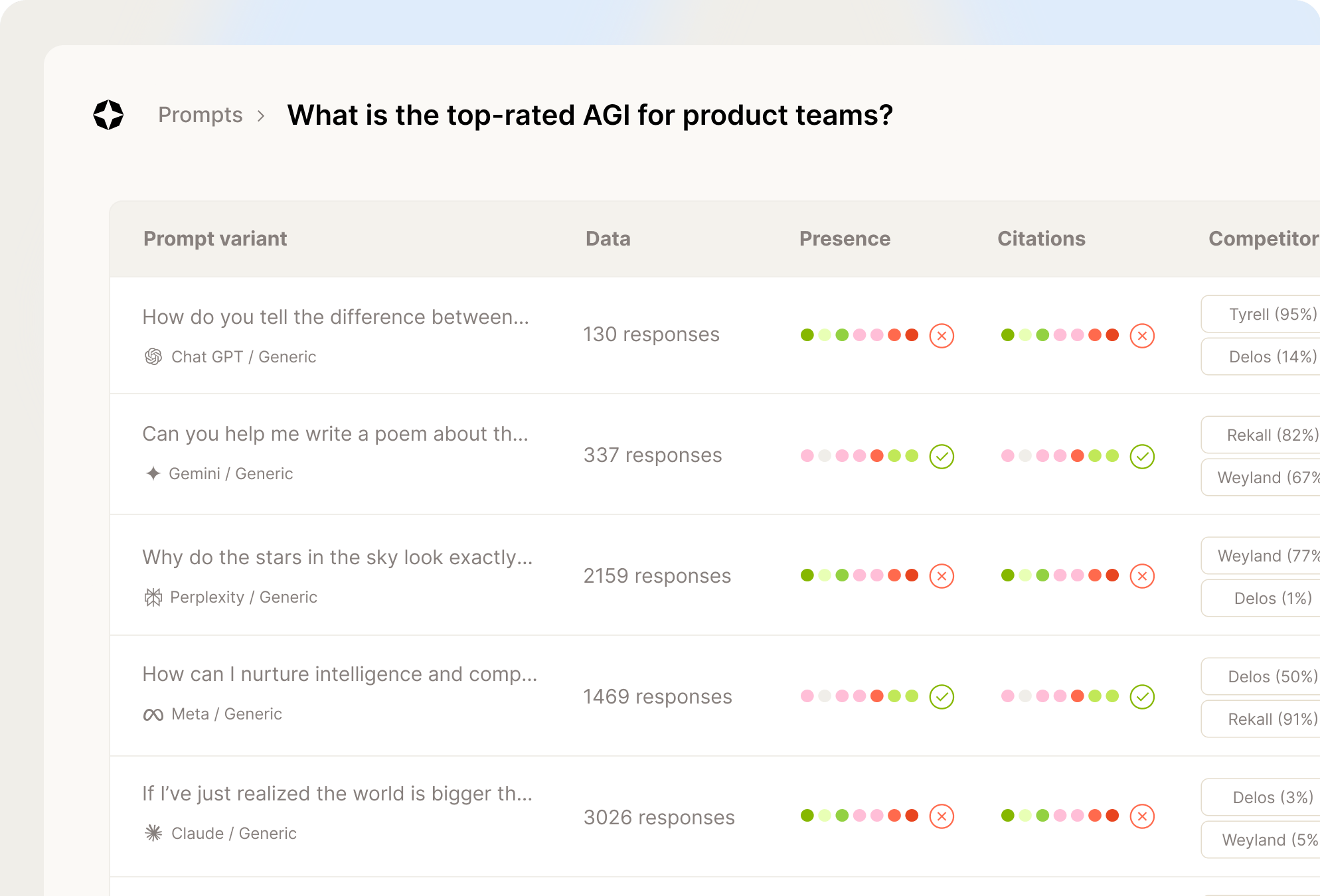
This is the part worth taking seriously on its own. An AI engine with no governed source of truth to draw from doesn't simply omit you when it lacks information, it sometimes fills the gap with a plausible-sounding but wrong version of what you do, drawn from outdated pages, a competitor's framing, or general training data. Catching a hallucinated service description or an out-of-date accreditation claim in an AI answer is arguably a more urgent fix than catching a missing citation, because it's actively misinforming a buyer rather than just failing to reach one.
Doing this manually for 20 to 30 prompts across four engines is tedious but doable for a first pass. Dedicated AI visibility tools such as Scrunch, Peec or Otterly automate the tracking and add competitive benchmarking once you want to monitor it on an ongoing basis rather than as a one-off audit.
AI engines weigh authority signals the same way search engines learned to over the past decade, just applied to a different output. A page that only asserts its own expertise gives a model nothing to verify. A page backed by third-party validation, specific case evidence, and consistent facts about the company across the web gives it something to lean on when deciding whose version of the answer to trust.
Reviews on G2 or Capterra, press coverage, a Wikipedia entry if you have one, industry awards from bodies you didn't pay to enter: all of these function as external confirmation that an AI engine can cross-reference against what your own site claims. A site with no footprint anywhere else on the web is asking the model to take its word for everything, which is a harder sell than it used to be.
This matters more than most sites realise. If your accreditations, team size, or service scope are stated differently across your website, your LinkedIn, your directory listings and a three-year-old press release, an AI engine has conflicting inputs to reconcile, and it often resolves that conflict by picking whichever version appears most often rather than whichever version is actually current, which is exactly why Blend's own accreditation claims stay limited strictly to what's currently verifiable on the HubSpot partner directory, rather than whatever's been sitting on a page since the last refresh.
An audit that ends as a list of 40 issues with no order to them gets actioned slowly, if at all, because nobody knows what to fix first, and the list itself starts to feel like the deliverable when it's really just the starting point.
Robots.txt access, schema markup, heading hierarchy, and rendering issues are usually technical, contained, and can often move within weeks once someone's assigned to them. These are worth clearing first, partly because they're genuinely urgent and partly because early wins keep a roadmap from stalling before the harder work starts.
Rewriting pages to answer questions directly, building out proof-dense sections, and closing prompt gaps where competitors currently win is a genuine content programme, not a sprint. It needs the same prioritisation as the technical fixes: which gaps cost you the most, and which pages get the most qualified traffic once fixed, should decide the order rather than whichever page someone happens to open first.
AI visibility shifts faster than organic rankings typically did, and a roadmap with no checkpoint tends to quietly stop getting checked at all once the initial audit excitement fades. Pick a date, put it in the plan alongside the fixes, and treat it as non-negotiable as the fixes themselves.
An audit is diagnosis, not treatment. Knowing that 12 of your 20 target prompts return a competitor and not you is useful information, but it doesn't rewrite the page, fix the schema, or produce the proof-dense content that would change the answer next time a buyer asks. That's the part most DIY audits stall on: the list gets built, gets presented in a meeting, and gets actioned on maybe a third of the items before something more urgent takes the team's attention.
A roadmap that actually gets worked through, rather than presented once and quietly shelved, is what Blend's AEO service is built to produce: technical fixes, content production and ongoing measurement run as one continuous programme instead of a report handed over and left to whoever has spare capacity that quarter.
If you want a clear read on where your own site currently stands in AI search, and what specifically would need to change to close the gap, book a consultation with Blend and we'll show you exactly what we find.
Speak with our team to discuss how we can help you build AI search visibility that's measured.