

Ready to find out exactly where your website is losing pipeline?
Speak with our team to see how we can help you turn your website back into a revenue asset instead of a brochure with a contact form.
A website generating healthy traffic can still fail at the only job that matters. When it does, the cause is almost always one of a handful of specific, checkable symptoms, not something vague like "needs a redesign." A mismatched CTA, friction on one specific page, sales quietly discounting website leads, or invisibility in the AI tools buyers now use to research each shows up differently and points to a different fix.
The trap is treating all of them as the same problem and reaching for the same fix, more traffic, a fresh coat of paint, instead of doing what Blend's HubSpot website design and development process does first: diagnosing exactly which specific gap is actually costing pipeline before a redesign is even on the table.
Last updated: 29 July 2026
Here's how to spot which one you've got.
| Symptom | Likely cause | Where to check first |
|---|---|---|
|
Sessions rising, conversions flat |
Weak or mismatched CTA |
Page-level conversion rate, not site-wide traffic |
|
High exit on one specific page |
Form friction or trust gap |
That page's bounce and exit rate in isolation |
|
Sales ignoring website leads |
Low-intent forms passing as qualified |
Lead-to-opportunity rate by source |
|
Buyers citing competitors, not you, in AI chat |
Weak AI/answer engine visibility |
Ask ChatGPT or Perplexity your own buyer questions |
|
Every fix needs a dev ticket |
CMS or platform constraint |
Time from "spot the issue" to "shipped fix" |
If your analytics look healthy but pipeline doesn't, the instinct is to spend more on getting people to the site. That's usually the wrong fix. A website with strong traffic and weak conversion isn't under-fed, it's leaking, and pouring more visitors into a leaking page just loses more of them, faster, at a higher cost per visitor.
Two numbers tell you which problem you actually have:
Blend's HubSpot website work with Viedoc doubled the new-user-to-MQL conversion rate from 0.7% to 1.4% in a single quarter, alongside a 14% increase in demo requests, simply by rebuilding around a clearer conversion path rather than adding more top-of-funnel spend.
Aggregate bounce rate is a blunt instrument. The page that matters is whichever one sits closest to the buyer actually raising their hand: the quote request, the demo booking, the pricing page. If that specific page has a high exit rate, no amount of homepage polish will fix it.
The usual culprits are mechanical, not mysterious:
Ask an agency to point at last month's checkout or quote-page numbers and you get a shrug. Ask about Blend's work with C.H.I. Overhead Doors, whose redesigned request-a-quote page lifted quote page conversion by 35%, and the answer is a specific page and a specific change.
Isolate the single worst-performing page and test changes there first. Redesigning a site that converts fine everywhere except one broken form wastes budget on the ninety percent that already works.
If reps are ignoring website-sourced leads, or quietly reworking them before following up, that's not a sales attitude problem. It's usually a sign the website is passing through low-intent contacts as if they were qualified. A form that only asks for a name and email fills a CRM with volume. It won't fill it with anyone sales wants to call.
Product-led positioning is a common root cause, a site that talks features and specs draws people evaluating the category, not people evaluating a purchase, exactly what Blend's three-year inbound programme with Robin Radar Systems replaced, swapping product-centric messaging for content framed around the buyer's actual problem and producing 48% more MQLs in the process.
Ask yourself: does the site's primary conversion action match how ready a first-time visitor actually is to talk? A "book a demo" button aimed at someone still comparing options forces a commitment they're not ready for, and either they bounce off it or submit it half-heartedly. Both outcomes look identical in the CRM: one more low-quality lead sales has learned to discount.
Website audits still assume the buyer arrives via search results or a direct visit. Increasingly, they don't. A growing share of B2B research now happens inside tools like ChatGPT or Perplexity, where the buyer never lands on your site at all, they read a generated answer and form an opinion from it. Your analytics show none of this.
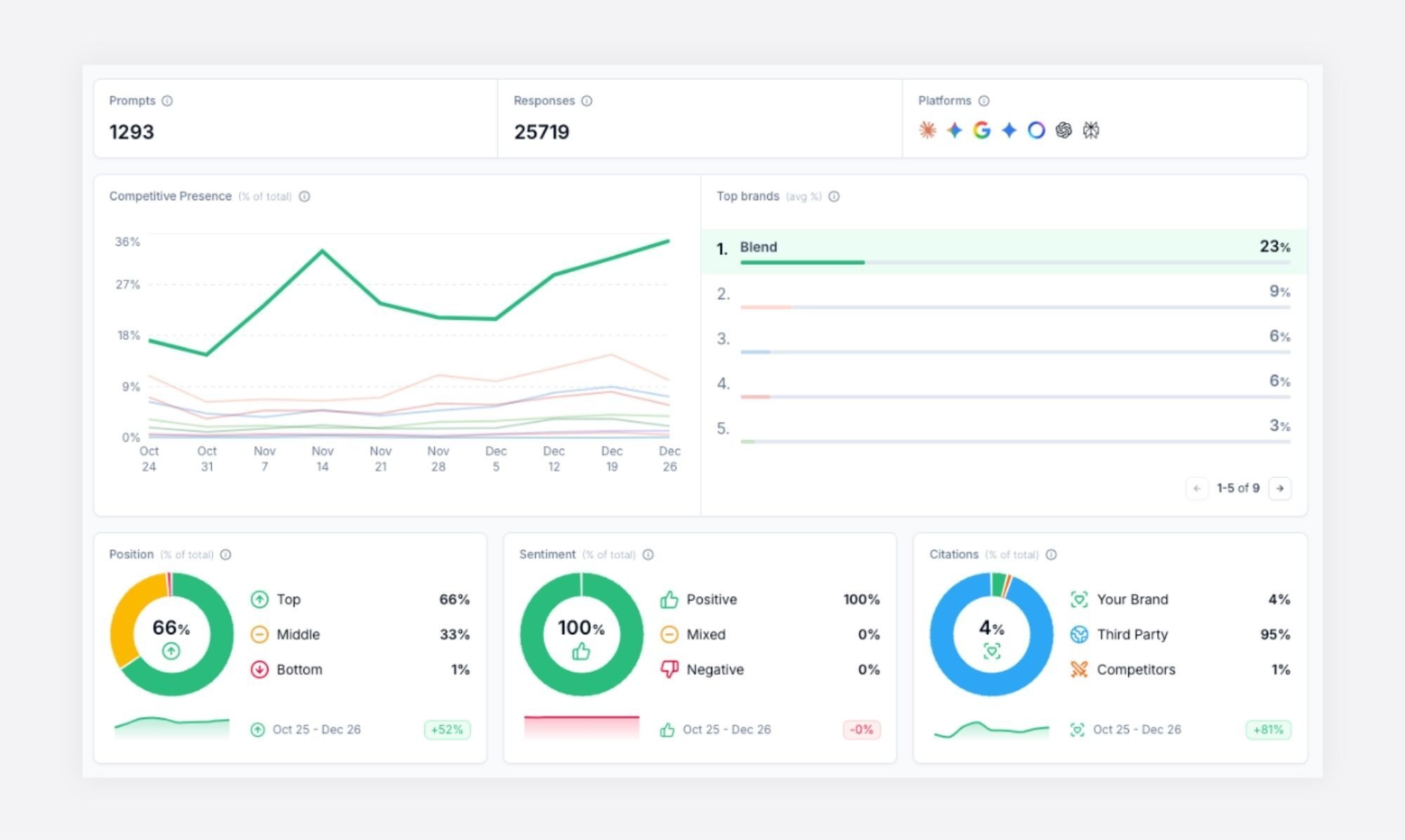
This is a different failure mode from the others: there's no bounce rate to point at. The symptom is an absence, you don't show up, or show up inaccurately, in the answers buyers get before they ever search your name, which is exactly the gap Blend's AEO services are built to check, testing your buyers' actual questions against which return your business by name and which return a competitor instead.
Some agencies route every content fix through an external development queue, turning a same-day change into a two-week wait. That delay compounds every symptom above: a broken form or a misjudged CTA stays broken for as long as it takes to get a slot in someone else's schedule.
Blend's in-house team of 50+ specialists means shipping a page fix doesn't depend on booking someone else's availability first, which matters more than it sounds once you've actually found the page that's costing you pipeline.
A website can win internal approval, look sharp in a pitch deck, and still fail completely at generating pipeline. This is the failure most teams are least prepared for: the site that "looks right" and converts nobody.
A B2B website succeeds or fails on one measure, and it isn't how it looks:
None of that shows up in a stakeholder review. All of it shows up in the conversion numbers three months later, once the excitement about the new design has worn off and only the data is left.
A brief built around what visitors actually do, not what's easiest to approve internally, is what Blend's website kick-off process delivers, covering research, analytics review, and scope agreement before a single page moves.
Work through this in sequence; checking page-level data before confirming the aggregate trend means you might test a fix that isn't even needed.
Most of this can be checked in an afternoon with analytics you already have. None of it requires a full rebuild to diagnose, even if the fix eventually does.
Every agency pitch promises a website that converts. The pitch was never the hard part. The hard part is what the site is still doing three months after launch, once the traffic bump has settled and only the numbers that separate a brochure from a revenue asset are left.
Blend is a HubSpot Diamond Partner with accreditations in CRM Implementation, Onboarding, and Content Experience, credentials that exist as evidence the process holds up after launch, not just in the pitch. If you want a direct read on whether your current site is generating pipeline or just collecting sessions, book a consultation with Blend and we'll tell you what we actually see.
Speak with our team to see how we can help you turn your website back into a revenue asset instead of a brochure with a contact form.