

Every business wants to be worth more tomorrow than it is today. Value creation is the plan for getting there, and your sales, marketing, and customer success teams have far more influence over it than most people realise.
This guide covers the three levers private equity (PE) firms use to increase a business's value, the quick wins they look for in the first 100 days, and what makes one business worth more than another at exit. Whether you're PE-backed, preparing for investment, or tightening up your RevOps to run a more efficient business, the same principles apply.
What is value creation?
Value creation is the difference between what a business is worth when an investor buys it and what it's worth when they sell it. In private equity, firms map out how they'll close that gap in a value creation plan (VCP), which begins with a 100-day plan as soon as the deal completes.
It's easy to see value creation as a board-level concern. But the metric at its core, earnings before interest, taxes, depreciation, and amortisation (EBITDA), matters to almost every business.
PE firms rely on it to measure progress, and investors in publicly traded companies scrutinise it alongside net earnings. For privately held and family-owned businesses, it's a key indicator of sustainability. So even if there's no exit on the horizon, understanding value creation will make you a more effective marketer, seller, or customer success leader.
The 3 levers of value creation
PE firms create value through three main levers, and your revenue teams can influence all of them.
| Lever | What it means | Where revenue teams come in |
|---|---|---|
|
EBITDA growth |
Growing real earnings (actual pounds and dollars, not percentages) |
Pricing, expansion revenue, and efficient pipeline |
|
Multiple expansion |
Selling at a higher multiple than you bought at, for example buying at 8x and selling at 12x |
Predictable revenue, consistent demand, and accurate forecasting |
|
Debt repayment |
Using the company's cash flow to pay off debt before exit |
Upfront billing, payment terms, and commission structures |
Together, these levers determine the multiple on invested capital (MOIC), which is how a PE firm judges whether its investment has paid off.
Multiples come with a caveat. They're shaped by the market as much as by the business itself. Investor appetite, the wider economy, and sector trends all affect them, and none of these are within your control.
That's why most value creation plans focus on EBITDA growth. It's the lever you can directly influence.
Quick wins in the first 100 days
Once the deal is done, the new board will want to see EBITDA grow early. Early, sustainable growth gives the business a step change rather than a gradual climb. The best quick wins share one trait: they don't require a sales cycle.
Tightening up discounting
Sales teams in businesses that haven't been PE-owned before often have considerable freedom to discount. It helps close deals, but it gradually erodes value. Expect the PE firm to ask your chief revenue officer to put firm controls in place.
Every pound of price you protect goes straight to EBITDA, because your cost to deliver hasn't changed.
Billing upfront
If you run a subscription business and invoice monthly, moving customers to annual upfront billing gives you the full year's cash on day one. This strengthens cash flow and, depending on the size of the business, can also generate interest income.
Getting your CRM in shape
PE firms expect detailed, consistent reporting that comes directly from your CRM. Manually adjusted spreadsheets won't give them the confidence they need.
If your CRM discipline isn't where it should be, the first 100 days will almost certainly include improving it across sales, marketing, and customer success. That means:
- Agreeing on what you call each metric
- Reporting against it consistently
- Making sure the data is being collected accurately
If you're preparing for investment, this is one of the most valuable things you can get right before due diligence begins.
Growing EBITDA beyond the first 100 days
Once the quick wins are in place, the focus shifts to growth that does involve a sales cycle. This is where revenue teams can make the biggest difference.
Start with your existing customers
Acquiring a new customer costs considerably more, and takes considerably longer, than expanding an existing one. So the first question after acquisition should be: where's the white space in our current customer base?
Look for opportunities to:
- Sell products or services customers don't already buy from you
- Expand into new geographies or business lines within existing accounts
- Deliver more value to each customer, rather than charging more for the same thing
This is often the area businesses have spent the least time optimising, which makes it one of the biggest opportunities available.
Focus on pipeline, not leads
In a PE-backed business, marketing's role is to drive sales, and to do so more efficiently than relying on the sales team to prospect their way to new customers.
That changes what you report on. Clicks, likes, and lead volume carry little weight with a PE sponsor. Qualified pipeline does, along with visibility into conversion rates, time to conversion, and how both vary by geography and customer segment. Any spend without a clear impact on pipeline is money taken out of EBITDA.
The question for sales and marketing should be: what's our path to the fastest, highest-converting pipeline? Answering it requires a deep understanding of your ideal customer profile (ICP), including what drives your buyers, who influences them, and where. From there, you can focus on helping more of them find you, using tools like intent data to identify who's in market.
Review your trade show strategy
Large trade shows are a common example of spend that doesn't always stand up to scrutiny. A significant budget goes into attending, a large volume of leads enters the CRM, and very little pipeline comes out of it.
That isn't the case in every industry. In some sectors, deals are genuinely done at events. But brand awareness alone is a difficult justification, because your presence needs to scale with the size of the show. If 20,000 people attend, a small booth in the corner is unlikely to make a lasting impression. Once you add travel, hospitality, and team time, the cost per meaningful conversation rises quickly.
A useful rule of thumb: if spending £500,000 to £1 million on a single trade show sounds unrealistic for your business, that show probably isn't the right fit.
There are usually more cost-effective ways to reach the same audience without competing with several direct competitors for their attention.
Shared metrics give sales and marketing a common language
Efficiency metrics turn value creation from a board-level concept into something your teams can act on. The most useful ones to agree on include:
- Customer acquisition cost (CAC) payback period: not just what it costs to win a customer, but how quickly that cost is recovered based on your cost of delivery and margins
- Win rates: broken down by segment and channel
- Sales cycle length: how long deals take, and where they tend to slow down
Investors pay close attention to these because the more efficient your revenue engine, the more confident they'll be investing in it. It's similar to performance tuning a car. The engine already runs well, but the right adjustments can deliver noticeably more from it.
When sales and marketing agree on these metrics, decision-making becomes easier too. Every investment, from campaigns to events, can be assessed against the same measures.
What makes a business worth a higher multiple?
Timing plays a significant role in exit multiples, and it's largely outside your control. One transportation technology business decided to sell when its sector reached a peak. By the time it went to market around nine months later, conditions had changed. The business itself was the same, but its valuation fell by just over 30%.
While you can't control the market, you can control the quality of the business you take to it. Two companies with the same EBITDA can achieve very different valuations.
Revenue quality and predictability
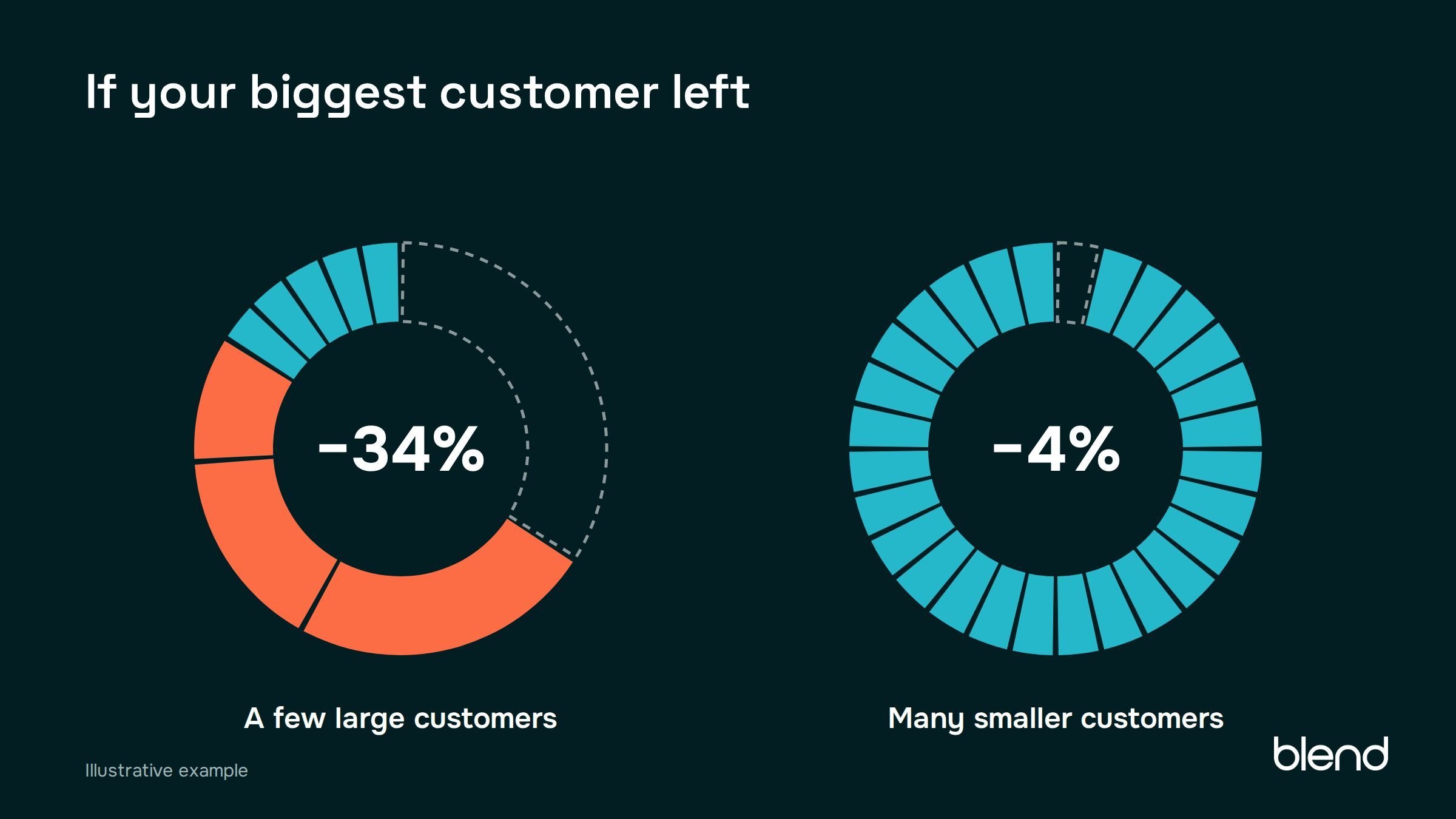
A high proportion of annual recurring revenue (ARR) is valuable because it’s predictable. Low customer concentration matters too. If a small number of customers account for a large share of your revenue, losing just one of them could remove a significant chunk of your revenue overnight. Buyers will factor that risk into their valuation.
Forecast accuracy is part of the same picture. During due diligence, you'll likely be asked for your last four quarters of forecasts and how the actuals compared. Consistently landing close to forecast is far more attractive than significant variation. Even exceeding your forecast by 25% can raise concerns, because it suggests a lack of visibility over your own business.
Process over personalities
A business that depends on its founder to sell, or on one high-performing salesperson whose results have never been replicated, carries risk. If that person leaves, can the results be repeated? Without a clear answer, buyers will value the business lower.
The same applies to marketing. A campaign that delivers a short-term spike won't carry much weight. Steadily growing demand will, because it shows you understand your ICP, reach them through multiple channels, and attract buyers your sales team can convert at a high rate.
PE firms don't want heroes. They want process creators who deliver a repeatable cycle.
This is also a helpful way to view due diligence. It can feel as though the buyer is looking for weaknesses to lower the price. In most cases, they're assessing:
- How far the business needs to go
- What it will cost to get there
- How strong the management team is
A business built on process makes that distance much clearer. Even if your EBITDA isn't quite where you'd like it to be, predictable demand can still earn a better multiple than a business that relies on individual performance.
How revenue teams can improve cash flow
The third lever, debt repayment, depends on cash. PE firms pay down debt using the cash the business generates, which means they retain more of the sale price at exit. Alongside upfront billing, revenue teams can help in two further ways.
Rethink when commissions are paid
Commissions can be one of the largest costs in a business, and their timing matters as much as their size. If a salesperson closes a three-year subscription and receives the full three-year commission upfront, the business has paid out cash it won't collect for years.
This isn't an expense issue, it's a cash issue. The commission is amortised over the life of the agreement, so the cost on paper doesn't change. What changes is when the money leaves the business.
Many sales leaders argue that top performers expect upfront payment, and there's some truth in that. But when that cash could be used to pay down debt, paying commission years before the revenue arrives is difficult to justify. The same applies to channel partner commissions.
Hold firm on payment terms
Enterprise customers increasingly ask for extended payment terms, and they often secure them because they hold the leverage. Holding firm isn't easy for a mid-sized business, but every improvement you protect strengthens your cash position.
2 priorities to act on now
If you lead a sales, marketing, or customer success team and want to start influencing value creation, there are two areas to focus on first.
1. Get the most out of your current customers
This is often the least optimised area of the business, and it's where growth is fastest and most cost-effective. Start by mapping the expansion opportunities across your existing accounts.
2. Make your CRM tell the full story
Consider whether your CRM covers marketing, sales, and customer success, or whether it's primarily a sales automation tool tracking pipeline. If it's the latter, it's worth addressing.
You don't necessarily need to replace your existing systems. If you're tied into contracts, integrating them is a practical first step. What matters is bringing everything into one place:
- Your existing customers
- Your prospects
- Your pipeline
- Your marketing activity
With that full view, you can properly understand the revenue side of your business.
Value creation is a team effort
Value creation isn't confined to the boardroom. Pricing, discounting, expansion, pipeline quality, forecast accuracy, and cash collection all sit with your revenue teams, and each has a direct impact on what your business is worth.
The businesses that achieve the strongest outcomes don't rely on one high performer or one standout campaign. They build connected systems and repeatable processes that make growth predictable. That's what investors are willing to pay a premium for, and it makes a business stronger whether an exit is planned or not.
Looking to build a revenue engine that drives value creation? Speak with our team to discuss how we can help you connect marketing, sales, and customer success into one system that delivers predictable growth.