
Ready to build a multilingual website that works in every market you operate in?
Talk to our team about creating a site that speaks to your international buyers with the same clarity and intent as your primary market.
Expanding into new markets is one of the most significant growth decisions a business can make. But too many companies invest in translation without investing in localization, and the result is a website that technically exists in multiple languages while feeling foreign in all of them. International buyers can tell when content was written for someone else and hastily translated for them. That disconnect costs you credibility, conversions, and pipeline.
Most agencies approach multilingual websites as a technical problem. They add a language switcher, pass content through a translation workflow, and call it done. What they miss is the strategic layer: how your information architecture changes across markets, how buyers in different regions evaluate trust differently, and how a website must be built from the ground up to scale across languages without becoming a maintenance burden.
This article evaluates 6 agencies that can build a multilingual website that performs commercially across markets. Each has been assessed for their approach to global web strategy, localization capability, and the business outcomes they deliver for clients operating across multiple markets.
| Agency | Location | Best For | Starting Investment | Notable Clients |
|---|---|---|---|---|
|
UK & USA |
B2B multilingual sites that convert globally |
From £30k |
PhoenixBio, Inshur, Viedoc |
|
|
USA |
Headless CMS multilingual for B2B tech |
Contact for pricing |
Calendly, Snowflake, ServiceTitan |
|
|
USA |
Multilingual builds for B2B with international SEO |
From $50k |
Novus, Rotor Clip, AIB International |
|
|
UK |
Global B2B multilingual with SEO |
Contact for pricing |
The Retail Mutual, Beyond Print |
|
|
Poland |
Enterprise-scale multilingual product design |
Contact for pricing |
IKEA, Volkswagen, Babbel |
|
|
USA |
Multilingual B2B websites for technical industries |
Contact for pricing |
McNally Industries, Monico Monitoring |
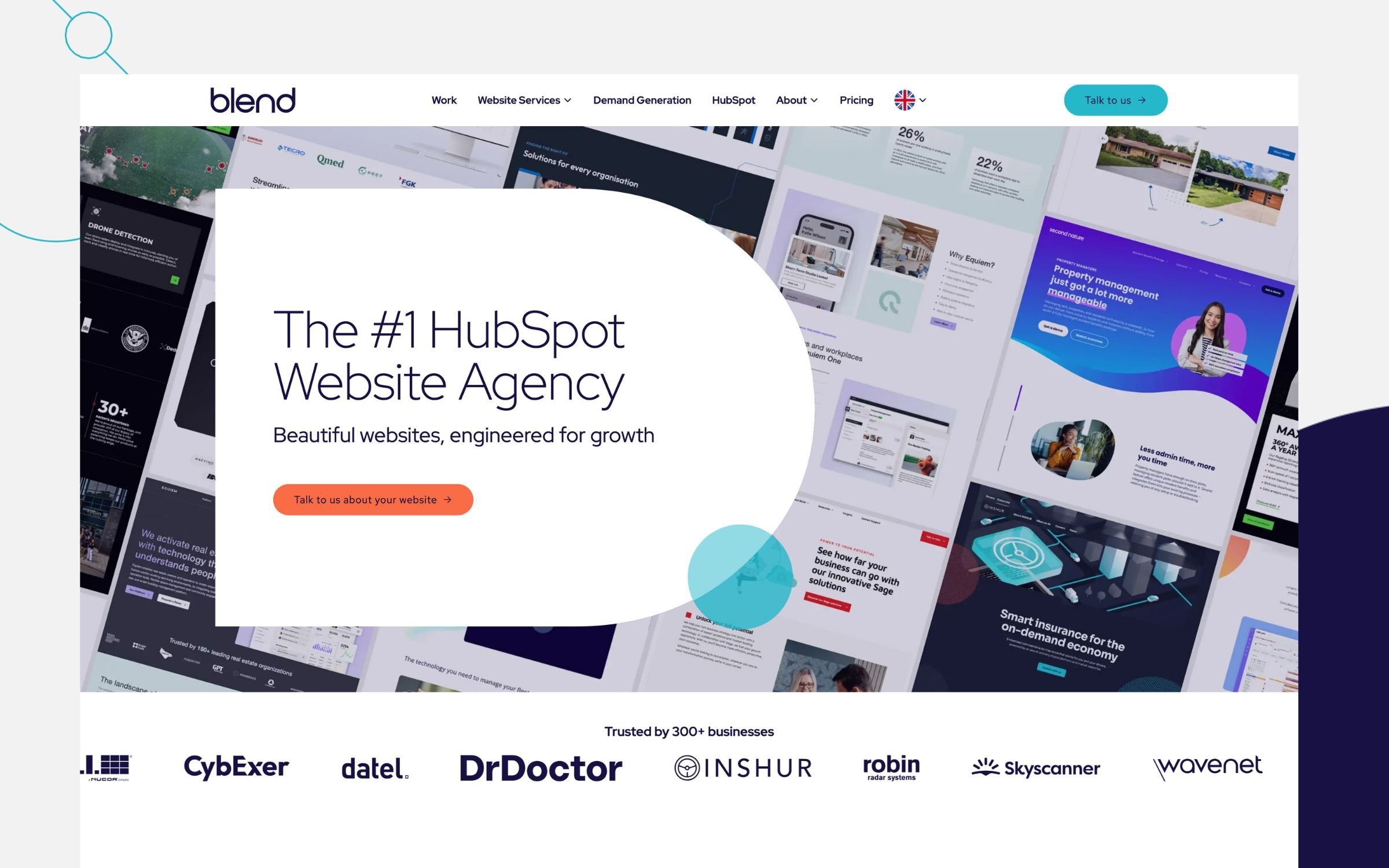
Blend is a B2B web design agency that builds websites for internationally operating businesses.
What makes Blend the best choice for multilingual websites:
B2B buyers researching in their native language expect content that addresses their specific commercial context, not a translated version of someone else's buyer journey. We approach each market as its own strategic challenge, building websites that serve international audiences with the same clarity and intent as the primary market, without multiplying complexity for your marketing team. Our experience spans businesses scaling from single-market to multi-region operations, which means we understand what needs to be built from day one to avoid expensive rework later.
Our process, refined across 10+ years of B2B website work, ensures that structure, content, and conversion paths are built for scalability from the start. Every multilingual website we build gives your team the control to update, expand, and grow across markets without relying on developers for every change. We design for the buyer in each market and measure success by pipeline generated, not pages published.
Proven results for clients with global reach:
Webstacks specializes in building modular, scalable websites for high-growth B2B technology companies, treating localization as a structural capability rather than an afterthought. Their approach uses headless CMS platforms such as Sanity, Contentful, and Storyblok, structured from the start to support multiple language versions within a single interface, with translation management systems including Smartling and Lokalise integrated into client workflows. They have delivered multilingual website work for globally scaled companies including Calendly, Snowflake, and ServiceTitan.
Orbit Media Studios is an award-winning web design and development agency with over 20 years of experience and more than 1,000 completed projects, with a strong track record in multilingual and international builds. Their multilingual portfolio includes Novus, a global agricultural feed producer rebranded with a bold multilingual site, and GoGlobal, a multilingual WordPress website serving Japanese and Chinese users, with in-house expertise in hreflang implementation, international SEO, and localized content governance. They work across WordPress, HubSpot, Drupal, and Contentful, and are a B Corp with a strong reputation for project management and client service.
Bird Marketing is a multi-award-winning digital agency with offices across London, New York, and Dubai, offering multilingual web design and development as part of a full-service digital offering. They combine culturally adapted content with technical SEO infrastructure including hreflang, regional URL structures, and localized metadata, with demonstrated results including a 189% boost in organic traffic for The Retail Mutual and a 237% increase in conversions following a website redesign. Their portfolio spans SMBs through to larger enterprises across retail, healthcare, technology, and financial services.
Netguru is a certified B Corporation software development and product design company with a team of over 630 designers and developers, specializing in enterprise-scale multilingual platforms for B2B technology, fintech, and retail companies. Their multilingual work includes a native-feeling multi-language platform for Babbel and web and product design for globally recognized brands including IKEA and Volkswagen across multiple regions and language requirements. They approach multilingual websites as modular design systems, building content models and UI patterns that support parallel releases across markets without breaking brand consistency.
Windmill Strategy is a B2B web design and digital marketing agency founded in 2006 and focused exclusively on technical industries including manufacturing, industrial automation, life sciences, and engineering. They bring specific multilingual and internationalization capability to technically complex B2B websites, combining website translation and localization strategy with international SEO to help clients reach global audiences in their native language. Their client base includes organizations with products sold across international markets, and they are a certified woman-owned business with a strong reputation for collaborative project delivery.
Choosing an agency for a multilingual website is different from choosing one for a standard redesign. The decisions you make at the architecture stage will determine how scalable, manageable, and effective your site is across every market you operate in. Here are the three things that separate agencies that truly deliver from those that simply offer multilingual as a checkbox capability.
Translation converts words from one language to another. Localization adapts your entire buyer experience for a specific market: the tone of your copy, the trust signals you use, the imagery and visual culture, the way you structure information, and even the calls to action you deploy. These are not the same thing, and the difference in commercial outcomes reflects that.
A capable agency will work with you before a single page is designed to understand which markets you are targeting, how buyer behavior differs across them, and what strategic adaptations are required. They will challenge your assumptions about what works in your home market and why it may not translate directly. The output is a localization strategy that your website is then built to execute, not a translation workflow bolted onto a finished design.
A multilingual website that cannot be efficiently maintained becomes a liability within six months of launch. Content goes out of date in some language versions. New pages get added in the primary language but never localized. SEO signals become inconsistent across regions. These are not hypothetical outcomes: they are the most common failure mode for multilingual web projects that do not begin with the right technical foundation.
Great agencies build multilingual architecture that makes ongoing governance manageable for your team. This means structured CMS content models that support parallel language versions, workflows that allow your marketing team to update and publish across markets without developer dependency, and technical SEO implementation including hreflang tags, canonical structure, and region-specific sitemaps configured correctly from day one.
The reason you invest in a multilingual website is to generate pipeline from international markets. Not to have a presence. Not to check a box on market entry. To grow. The agency you choose should be able to point to specific, measurable results they have delivered for clients operating across multiple markets, not just a portfolio of beautifully designed international sites.
Look for case studies that reference conversion rates, qualified leads, organic visibility, or pipeline generated from specific markets. Ask directly what results their multilingual clients have seen, and how long after launch those results began to materialize. Agencies that have genuinely delivered in this space will have data. Those that have built nice-looking international sites without focusing on commercial outcomes will have aesthetics.
Before you approach any agency, know which markets you are targeting, which language versions are genuinely required for commercial performance, and what your team's capacity is to manage localized content ongoing. This shapes every subsequent decision about CMS architecture, workflow design, and scope. An agency that starts by asking you these questions before discussing design is thinking commercially, not just creatively.
Ask prospective agencies to walk you through how they approach a multilingual project from the first strategy session. Specifically, ask how they handle cultural adaptation beyond translation, how they advise on information architecture across markets, and how they have approached buyer journey differences in previous projects. An agency that talks primarily about translation workflows and language switchers is not thinking at the right level for a high-performance multilingual website.
Ask to see the CMS content model they intend to use, how it supports multiple language versions, and how your team will publish, update, and add content across markets after launch. Request detail on their hreflang implementation approach and how they structure international SEO. If an agency cannot explain these elements clearly, or presents them as minor technical details rather than foundational decisions, treat that as a warning sign.
Ask specifically for case studies from clients with multilingual websites, and ask for measurable outcomes from those projects: traffic growth in target markets, conversion rate changes by region, or lead volume from international audiences. Portfolio images of multilingual sites tell you about design capability. Results data tells you whether those sites performed commercially.
Multilingual websites evolve. Markets change, teams change, and your localization strategy will develop as you learn what works in each region. You need a partner who can support you through that evolution, not just deliver a project and hand over the keys. That is the distinction between an agency that builds multilingual websites and one that treats your international presence as an ongoing commercial asset.
Blend is our top choice for businesses building multilingual websites that need to deliver commercial results across markets. We combine strategic localization thinking with deep B2B web design expertise, approaching each market as its own commercial challenge rather than a translation exercise. Our work with international B2B clients has produced measurable outcomes: Viedoc doubled their new user to MQL conversion rate following our redesign of their global website, while PhoenixBio now reaches both English and Japanese-speaking markets through a multilingual build designed to bring their life science research to a global audience.
What sets Blend apart is the combination of strategic depth and practical delivery. We build the CMS architecture, content governance, and conversion paths that allow your team to manage and grow across markets without developer dependency, and we measure every project by the pipeline it generates, not the pages it publishes. If you are building a multilingual website that needs to perform commercially from day one, Blend is the partner to start with.
Look for agencies that treat localization as a strategic discipline rather than a translation workflow. Your agency should have a clear methodology for adapting buyer journeys across markets, not just converting copy between languages. They should be able to demonstrate specific commercial outcomes from previous multilingual projects, explain their technical approach to CMS architecture and international SEO, and show you how your team will manage the site ongoing after launch. Cultural adaptation capability, hreflang expertise, and content governance design are the three areas most often underweighted by agencies without genuine multilingual specialization.
Multilingual website investment varies significantly depending on the number of target markets, the complexity of your content model, and how much strategic localization work is required beyond technical build. Blend starts from around £30,000 for a strategically designed multilingual site, with investment scaling based on the number of language versions and the level of localization strategy involved. Budget separately for translation and localization of content, which is usually managed outside the web agency relationship.
A well-structured multilingual website typically takes between 16 and 30 weeks from strategy to launch, depending on the number of language versions, the volume of content requiring localization, and the complexity of your CMS setup. Projects at the more complex end, involving five or more languages and significant content governance work, can run longer. Businesses that invest time upfront in localization strategy and content governance planning consistently deliver faster and see better post-launch performance than those who treat translation as a late-stage project task.
Results depend heavily on how strategically the localization work is approached, not just how technically correct the website is. Businesses that invest in genuine market adaptation alongside strong web design consistently see meaningful improvements in international traffic and qualified lead volume. Viedoc doubled their new user to MQL conversion rate within the first quarter of launch following Blend's redesign of their global website. Realistically, allow three to six months post-launch for organic performance to stabilize in new markets before evaluating international SEO impact.
Not necessarily, but you need to be honest about whether your primary agency has genuine depth in each market you are targeting. For most B2B businesses entering one or two new language markets, a specialist multilingual web agency combined with a native translation partner will serve you well. For businesses expanding into five or more markets simultaneously, consider agencies with broader international team structures, or build a partnership model where a strategic web agency works alongside in-market content specialists. The key question is not how many agencies you use, but whether the strategic direction for each market is owned by someone who understands both your commercial goals and the cultural context of that audience.
The agencies on this list represent a range of multilingual web design approaches, from generalist digital agencies with international SEO capability to specialist B2B partners with a deeper focus on commercial outcomes. Each has a different strength and a different ideal client, which is why the right choice depends on understanding your own requirements before you start comparing options.
The right choice comes down to what your business actually needs. A company entering two new European markets needs a different partner than one managing ongoing localization across eight languages. Your team's internal capability to manage content post-launch matters as much as the agency's build quality. And your timeline and budget will shape which level of strategic investment is genuinely achievable.
The most important thing to internalize before you choose: a multilingual website is not a project with a delivery date. It is an ongoing commercial asset that will determine how effectively your business generates revenue in international markets for years to come. Choose the partner who treats it that way.
Blend sits at a specific intersection that most agencies cannot occupy: deep B2B web design expertise combined with a strategic approach to international market performance. We are not a translation agency that also builds websites, and we are not a generalist web agency that offers multilingual as an add-on. We design websites from the ground up to perform commercially across markets, with the structure, content strategy, and technical foundation to scale as your international footprint grows.
Our clients operating across multiple markets reflect the range of multilingual challenges B2B businesses face. PhoenixBio needed a website that could bring ground-breaking life science research to audiences in both English and Japanese-speaking markets. Inshur, a fintech platform operating across the US, UK, and Netherlands, required a website that could maintain brand consistency and conversion performance across three distinct markets. Viedoc, a European SaaS company serving global clinical trial markets, doubled their new user to MQL conversion rate following our redesign.
We bring that same commercial focus to every multilingual project: designing for the buyer in each market, building for the team managing content across languages, and measuring success by pipeline generated rather than pages published.
If you are ready to build a multilingual website that works as hard in Munich or Tokyo as it does in London or New York, let's talk. Book a strategy call to discuss your multilingual website.
Talk to our team about creating a site that speaks to your international buyers with the same clarity and intent as your primary market.