

If your CFO keeps saying no to your marketing budget, the problem probably isn't the CFO. It usually starts with how marketing budget planning is done, and the way marketing asks.
Most marketers walk into budget conversations asking for money to spend. CFOs think about money to invest. They make decisions on risk and return all day, yet marketing budgets are rarely presented that way. Close that gap and the conversation changes completely.
This guide covers what good marketing budget planning looks like, why marketing budgets get cut, and eight practical steps to build a B2B marketing budget your finance team can actually get behind, built on predictable pipeline.
At the heart of it is CMO and CFO alignment, which is exactly what we unpacked on the Demand Decoded podcast. Watch the episode below, then read on for the full framework.
What is marketing budget planning?
Marketing budget planning is the process of deciding how much to invest in marketing, where that money goes, and what return you expect from it. Done well, it isn't a spreadsheet exercise marketing does alone. It's built on CMO and CFO alignment.
That alignment is when marketing and finance agree on what marketing is there to achieve, how success is measured, and how money moves between channels.
Instead of an annual tug of war over budget, both sides work from a shared revenue plan, shared definitions, and a shared view of risk. Marketing presents its spend as an investment with an expected return. Finance gets the clarity it needs to back it.
Why your marketing budget keeps getting cut
When you've spent weeks on a budget proposal and it gets cut, it can feel personal. It usually isn't.
A CFO is judged on how reliable the financial outcomes they deliver are. When a request is full of unknowns, the safe answer is no. And if marketing presents itself as a cost centre, it becomes an obvious place to look when costs need trimming.
So the job isn't to win the CFO over with enthusiasm. It's to reduce their uncertainty. To justify your marketing budget, show them:
- The analysis and planning behind your request
- The risks involved and how you'll reduce them
- What happens if outcomes don't land as expected, and how you'll respond
When a CFO can see that you've already stress-tested your own plan, they're far more comfortable supporting it.
Attribution gets in the way
Marketing attribution is hard. Everything you do affects everything else. Someone might visit your stand at an event because they saw your sales rep's LinkedIn posts, or an ad, or just know your brand. That story is very difficult to tell in a spreadsheet.
So don't try to win a budget argument with channel-by-channel attribution. Very few CFOs want to become experts in it.
If you hand over a forecast saying a channel will deliver a specific number, their analysts will check it. Attribution can't be forecast that precisely, so the numbers won't match. That introduces doubt and makes your whole request look less credible.
Attribution data has its uses. Leading a budget request isn't one of them.
How to create a marketing budget your CFO will approve
A marketing budget your CFO will back doesn't come together in one meeting. It's built through how you plan, how you present, and how you react when things change. Here are eight steps to get there.
1. Ask for capital, not budget
This is the reframe that makes everything else work. A budget is something you spend. Capital is something you invest, with a clear expected return.
When you ask for investment capital, you have to be clear about:
- The outcomes you plan to produce
- The return on that investment
- When that return will arrive
That's the language your CFO already speaks, and so do your board and investors. If your business is private equity (PE) backed, marketing's role is to help create EBITDA, either by delivering the same outcome for less or by generating revenue at a rate that justifies the extra spend. Frame your request around that and you're no longer the optional line item.
2. Build your marketing budget plan around the sales plan
Marketing budget planning works best when sales is part of it too. Start with what sales has promised and what sales needs to deliver it.
Sales is accountable to a number, but pipeline comes from many places, not from sales alone. If you can map your investment proposal to the ingredients sales depends on, you're on much firmer ground.
That means agreeing with your sales leader on:
- How qualified pipeline is defined
- How much pipeline is needed, and by when
- What's needed each quarter to stay on track
Once you're aligned, your request becomes simple. Here's what we need to deliver, here's how we'll deliver it, and here's what you can hold us accountable for. The CFO doesn't need to second-guess every channel decision. They hold you to the pipeline.
Sharing accountability with sales
Some marketers will baulk at this. How can you be accountable for revenue when you're not the one selling?
The answer is that sales doesn't fully control its outcomes either. Market shifts, economic changes, and world events all have an impact, and that's true for every function in the business. Sharing accountability with your sales counterparts is part of being taken seriously.
3. Show your CFO the risks (and your plan B)
A strong request shows the expected return and the timing, based on real sales cycle lengths. To do that, you need to understand how the whole business gets to revenue, not just marketing's part of it.
Then show what happens off the happy path. If you're behind in one area, what can you dial up? Where can you pull back? How quickly will you react?
Most importantly, make it clear you're watching the numbers and you'll change course before anyone tells you to. That's what builds trust.
Are events worth the budget?
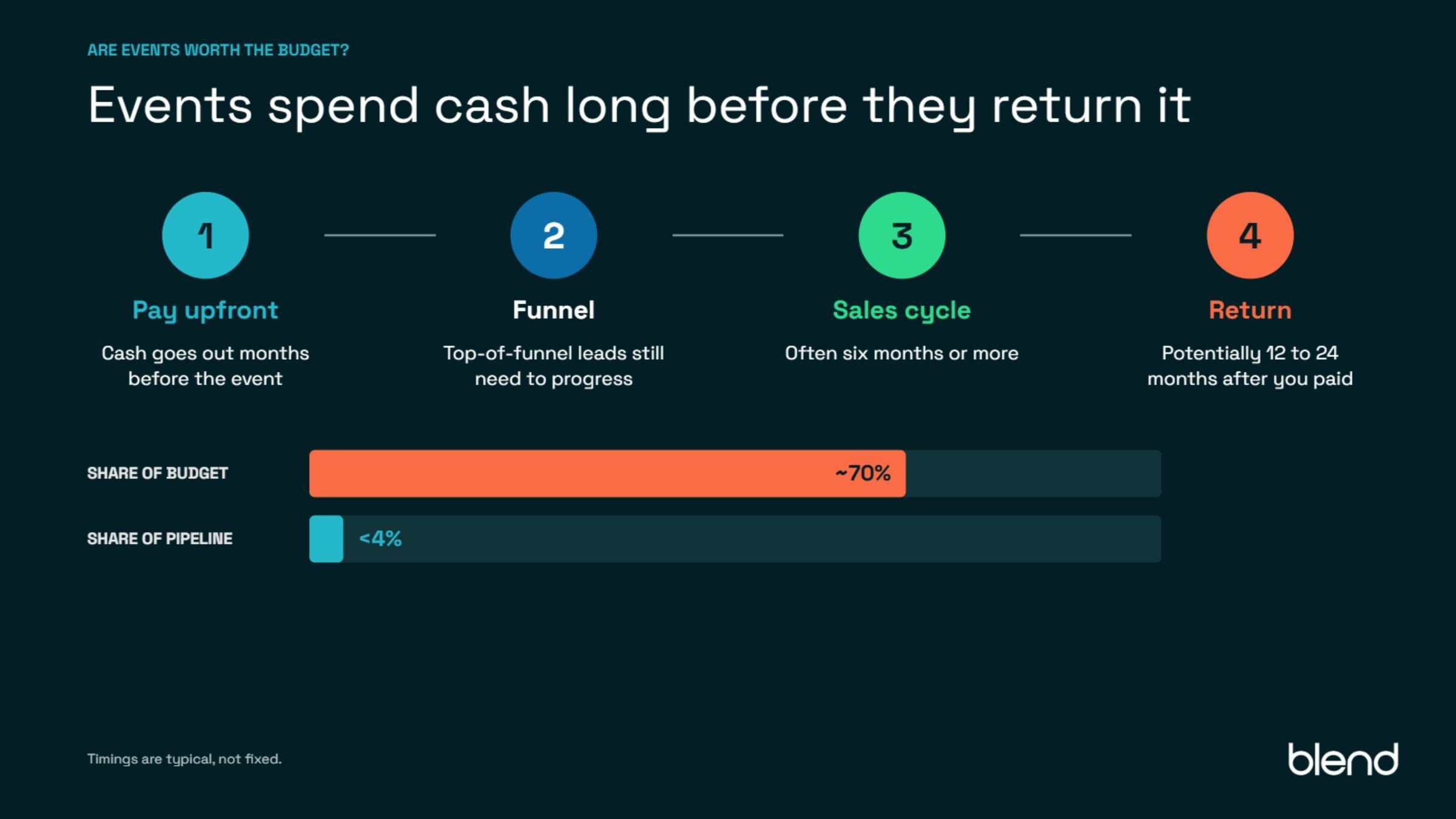
This is where some favourite channels need a hard look. For one B2B business we analysed, events accounted for less than 4% of pipeline while consuming around 70% of the marketing budget. Their sales team had insisted on attending for years, and marketing had gone along with it.
Why the attachment? Often it's fear of missing out. "We've been going for 30 years, how can we not be there?" But being there doesn't guarantee a return, and by day three, the aisles are often quiet for everyone.
Events also have a cash problem. Here's how the timeline usually plays out:
- You pay months in advance for something at the very top of the funnel
- Leads have to move through your marketing funnel
- Then they go through a sales cycle of six months or more
- The return on that cash might not arrive for 12 to 24 months
That's a tough bet for any CFO, and much tougher if the data shows a tiny share of pipeline.
To be fair, events can work. If your solution addresses something most attendees care about and you can afford a dominant presence, the return can be meaningful. Smaller, focused formats can perform brilliantly too.
But for the average mid-market B2B business with a small stand tucked in a corner, solving a problem that 10 to 15% of attendees care about, the return is hard to deliver.
Branded search can inflate your results
Finance teams tend to love Google Ads because return on ad spend (ROAS) is easy to report. But look closely.
If your best-converting ads are all branded campaigns, many of those people were probably going to find you anyway. Strip them out and the picture can look very different. That's spend you might not need, even though it looks great on a report.
4. Start from zero, not last year's marketing budget
A lot of marketers take this year's budget and adjust it, usually upwards. Next year won't look like this year, especially with how quickly the B2B technology sector is changing. Starting from last year's figure assumes the spend was right in the first place.
Build from what you need to achieve instead, and factor in risk. If additional investment is expected to generate more revenue, estimate the likelihood it won't happen and adjust the expected outcome accordingly. That gives you a risk-adjusted return.
If you haven't read up on risk-adjusted returns, it's worth doing. Your CFO knows them well, and so does any PE firm involved. Present your plan that way and you're showing you've already thought like they do.
5. Build a joint revenue plan
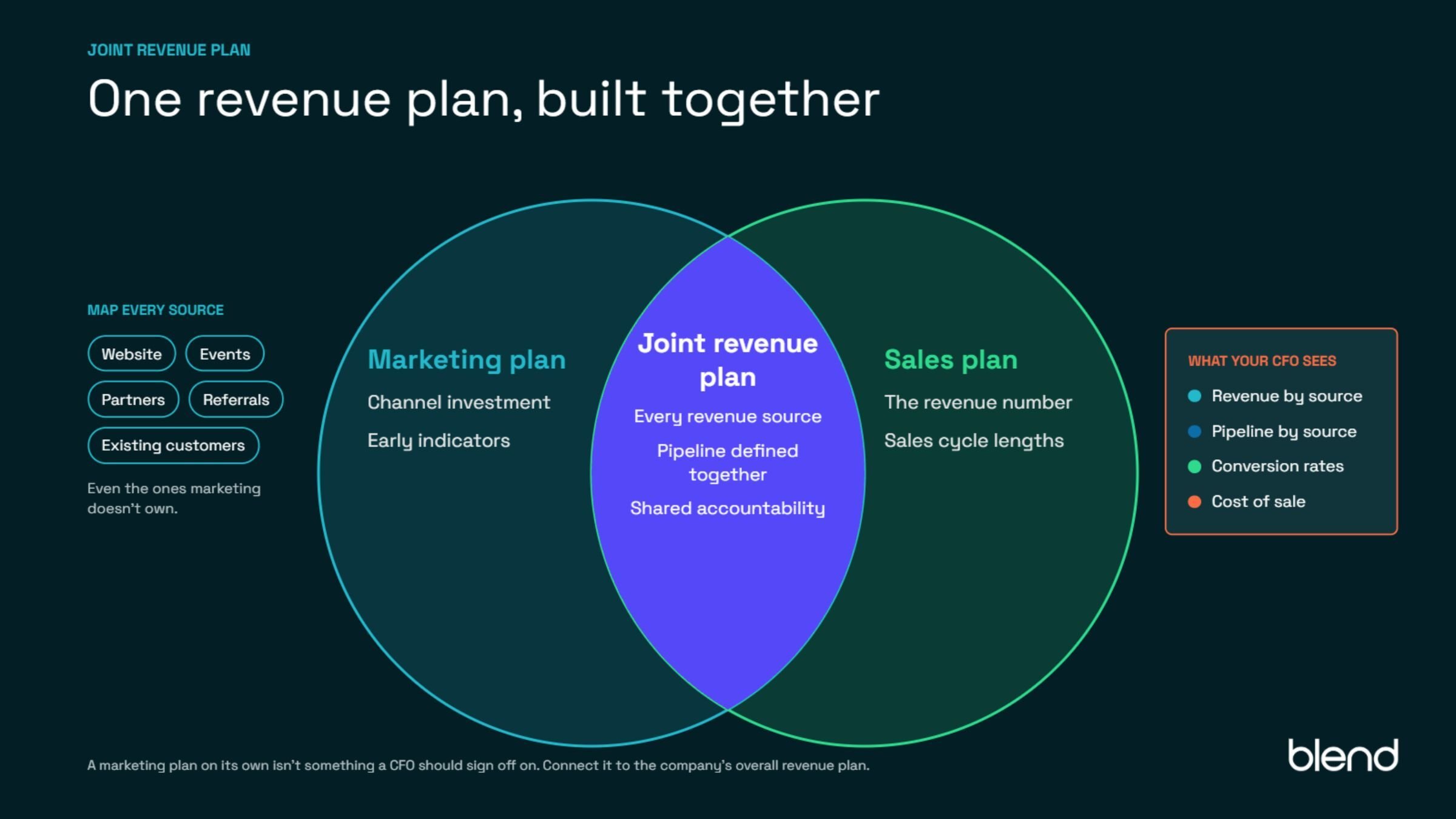
A marketing strategy on its own isn't something a CFO should sign off on. It should connect to the company's overall revenue plan, built with your sales leader and covering every source of revenue.
Even if you don't own every channel, map them all:
- How much revenue comes from each source
- How much pipeline each one generates
- Conversion rates for each
- The cost of sale
Getting this view often means pulling data out of separate sales and marketing systems, which is where RevOps earns its keep.
Think of your revenue engine as a profit and loss account, and let that drive your marketing budget allocation. Taking a pound out of one area and putting it into partner channels or account expansion might deliver far more. If you only look at your own slice, you risk being deprioritised because the decision makers don't have the full picture.
This is also where you can become invaluable. CMOs often have the skills to run this analysis well, and doing it raises marketing's standing across the business.
Track the early indicators
If your sales cycle is long, most of this year's marketing spend won't show up in this year's revenue. Your CFO still cares, because they're working to a three-to-five-year plan.
Agree on the early indicators that give you confidence revenue will follow, and the points at which you'll check them. That gives your CFO something concrete to track long before the revenue arrives.
6. Ring-fence 10% of your marketing budget for testing
The best way to try something new without putting the whole budget at risk is a ring-fenced test budget, agreed upfront with your CFO as money for placing bets.
Around 10% is a sensible starting point. It's the same thinking behind the 70/20/10 rule many marketers use for budget allocation: roughly 70% on proven channels, 20% on promising ones you're scaling, and 10% on new bets. One enterprise CMO used a test pot like this to shift her team from traditional lead generation to demand generation, proving the approach before rolling it out across the business.
Two mistakes to avoid:
- Testing too small. One business planned a test on a low-revenue product in a single country. Even if it worked, it wouldn't have been material enough to justify scaling. You have to risk something meaningful.
- Testing too big. Putting your entire budget into an untested approach isn't a test. It's a gamble.
Where should your test budget come from?
Your CFO's first question will be where the test budget comes from. Have the answer ready, and take it from something that isn't performing.
Here's our own example. We'd attended one large event for years without it coming close to a return. In late 2025, we started hosting small dinners for 12 to 16 senior leaders on growth strategy topics. They cost very little to run, attendees learn a lot from each other, and the pipeline has been excellent.
So next year we're tripling the number of dinners, expanding the regions we host them in, and dropping the big event.
That's the story CFOs want to hear. You wouldn't trust a broker who kept you in a stock that had fallen 80% over ten years "because it'll come back eventually". Show you'll move money away from underperforming investments and your CFO has a reason to trust you with more.
Leads or just names?
When a big event produces "10,000 leads" that convert at 1 to 2%, it looks like marketing failed. Many of those people simply stopped by for a branded water bottle. They're names, not leads. Calling them what they are protects your credibility.
7. Build the financial model together
Most marketing leaders aren't financial modellers, and they don't need to be. Your CFO has people who are. Ask for a financial analyst to work with you, and split the work:
- Your job: explain how the business, marketing, and sales actually work
- Their job: turn that into a model with the right levers, including what happens if you cut spend in a particular area
Building it together is CMO and CFO alignment in practice. Your CFO now has a stake in what you've created, and it makes their story to the board much stronger.
You need a narrative and a spreadsheet
Boards and PE firms won't approve a plan from a slide deck. They'll want a detailed spreadsheet their analysts can pick apart.
The narrative still matters, because it explains your thinking and gives the numbers context. But without the spreadsheet, the PE firm will build its own model. It'll have less context about your business, and it may well come back with a no.
8. Think beyond the hold period
If you're PE-backed, you might assume investors only care about returns within their hold period. Partly true. Speed to revenue matters, and it directly affects your payback period.
But it's a mistake to think they don't care what happens after they sell. Every PE firm wants to sell a quality asset at top value, and buyers look closely at what came before. If they can see that marketing spend was slashed in the final 18 months and pipeline fell away, they'll value the business lower. Higher EBITDA in the short term can mean a lower multiple, because the new owner has to rebuild the growth engine with their own money.
Sophisticated buyers would rather pay a higher multiple for a healthy business that's positioned to keep growing. The best way to maximise exit value is to build a great business.
Marketing budget planning FAQs
How do you justify a marketing budget to a CFO?
Present it as investment capital, not spend. Show the outcomes you'll deliver, the expected return and when it will arrive, the risks and your plan B, and how you'll move money away from anything that underperforms. Tie it to the pipeline sales needs, not to channel-by-channel attribution.
What is the 70/20/10 rule for marketing budgets?
It's a simple way to split a marketing budget: around 70% on proven channels, 20% on promising channels you're scaling, and 10% on experiments. The 10% works best as a ring-fenced test budget agreed with your CFO upfront.
How should a B2B company allocate its marketing budget?
Start from zero rather than last year's figures. Build a joint revenue plan with sales that maps revenue, pipeline, conversion rates and cost of sale for every channel, then put money where the return is strongest. Check the share of pipeline each channel really drives, especially big-ticket items like events and branded search.
Marketing budget planning that turns a no into a yes
When budget planning season comes around, it's tempting to dust off last year's spreadsheet and add a bit. Resist it.
Partner with your sales leader and your CFO. Build a joint revenue plan, present your request as investment capital with risk-adjusted returns, and show you're prepared to move money away from what isn't working. That's what CMO and CFO alignment looks like in practice, and it's how a budget conversation becomes a business conversation.
Looking to build a marketing engine your CFO can believe in? Speak with our team to discuss how we can help you drive measurable pipeline and revenue.