

As businesses plan for next year, one question keeps coming up in leadership meetings: should marketing have a revenue target? Some marketing leaders want one. Others push back hard, leaving CEOs and CFOs unsure what marketing is really accountable for.
The short answer is yes, marketing should share the target. But it probably isn't a revenue target at all, and understanding why is the first step to earning a real seat at the leadership table.
What is revenue marketing?
Revenue marketing is an approach where marketing is measured on its contribution to closed business, not on activity metrics like Marketing Qualified Leads (MQLs), clicks, or form fills. Instead of handing leads to sales and stepping back, marketing stays accountable across the whole revenue lifecycle: from the first touch, through the pipeline, to the closed deal and the customer growth that follows.
In practice, revenue marketing comes down to three things:
- Marketing shares the company's bookings target with sales.
- Every marketing investment is tied to the business outcome it's meant to influence.
- Marketing works from the same data as everyone else, so it can see what happens to the pipeline it creates.
It's a shift away from measuring lead volume, which tends to produce plenty of contacts and not many buyers. Revenue marketing asks a harder question: did this activity help the business win and keep customers?
Bookings vs. revenue vs. cash: why the words matter
Before deciding whether marketing should own a revenue target, it's worth checking what "revenue" actually means. In sales and marketing teams, the word gets stretched to cover closed-won pipeline, signed contracts, and anything else with a currency symbol next to it. Your CFO uses it to mean something far more specific.
There are three terms worth separating.
Revenue is income the business recognises as the customer receives value. Under revenue recognition rules, a SaaS business can only start recognising subscription revenue once the customer is actually using the software. Sign a customer to a 12-month subscription with instant access, and you recognise a twelfth of that fee each month.
Cash is money in the bank. If that same customer pays for the year upfront, the cash arrives all at once. CFOs like this, because your customers are financing your business rather than the other way round.
Bookings are the total value of a closed deal, regardless of term or billing structure. A 12-month subscription books the full year. A three-year deal books all 36 months.
Why a marketing revenue target is really a bookings target
This is why most sales teams, particularly in the US, are incentivised on bookings rather than revenue or cash. Bookings reflect what the sales team actually closes, however the deal is structured. The business then models those bookings into its revenue forecast.
Plenty of CEOs, CROs, and sales leaders will still call it a revenue target. Call it nitpicking if you like, but precise language is part of how marketing earns credibility with finance. For the rest of this guide, when we talk about marketing's target, we mean bookings.
Should marketing have a revenue target?
Yes. More precisely, marketing should share the company's bookings target with sales and be held equally responsible for hitting it.
It's easy to assume marketing's influence ends the moment a qualified lead becomes pipeline. That's usually where marketing leaders draw the line themselves: "we've handed it over, it's sales' job now." But marketing can have a huge impact on what happens next, from conversion into pipeline, to closed-won deals, to bookings.
How marketing drives pipeline acceleration after the handover
There are entire disciplines built around what happens after a lead reaches sales:
- Pipeline acceleration focuses on moving deals through the funnel faster.
- Lifecycle marketing keeps the right message in front of buyers and customers at every stage.
- Sales enablement gives sellers the tools they need to sell.
Sales teams are hired to sell, not to design collateral or write messaging. Marketing is trained to understand an ICP and communicate with a market, so sales sequences and enablement content are a natural fit.
Why long B2B sales cycles strengthen the case for a revenue target
One common objection comes from businesses with long enterprise sales cycles. If a deal takes 18 months to close, marketing's impact on bookings might not show for two years once you add ramp-up time.
We'd argue that makes the case stronger. A buying committee deliberating for 18 months needs to keep hearing from you, and that's a lot to ask of one sales rep. Marketing's job is to get a relevant message to the right people at the right time, whether they've never heard of you, are in your pipeline, or are already a customer.
Why marketing leaders push back on revenue targets
In our experience, it's rarer for a marketing leader to refuse a target outright than to have one forced on them. But when they do push back, it's usually for understandable, if not entirely convincing, reasons.
MQL targets are easier to hit
If marketing's bonus is tied to something it fully controls, like MQL volume, it's far easier to hit. Pay a marketing team on MQLs and you'll probably notice a few new cars in the car park. A bookings target is a different matter.
There's also a cultural gap:
- Sellers grow up with a target on their back from day one, so signing up to a number feels normal.
- Marketers rarely face that kind of pressure until much later in their careers, if at all.
Accepting a bookings target means accepting you can't control everything. What you can control is how closely you align with sales and how well you support them.
Why "we set the table" isn't enough for marketing leaders
The other common argument goes something like this: marketing sets the table, and sales is responsible for the meal. Marketing generates the pipeline, so marketing shouldn't be measured on what happens to it.
It's a tactical view of the role, and it creates two problems for any marketing leader who wants a strategic seat at the leadership table.
- You can't claim success when the company hasn't succeeded. If marketing hits double its pipeline goal but the business only reaches half its bookings target, asking for bonuses isn't reading the room. A sales leader can easily go through that pipeline lead by lead and explain why each one was junk.
- It limits marketing's value. The revenue lifecycle runs from product-market fit and messaging, through sales, implementation, and onboarding, to customer success and growing wallet share. Marketing can add value at every stage, from sharper sales enablement to clearer implementation communications.
The marketing leaders who earn a seat at the table think more broadly. They're there to make every team successful, not to sit in the corner creating leads and claiming the credit.
How to prove marketing ROI to your CFO
Here's the hard part. Your CFO walks into the room, says they're glad everyone's having lots of conversations and adding value, and then asks the question that matters:
How do we measure the value of marketing?
Signing up to the bookings target is part of the answer, especially when it's split into new logo acquisition and existing customer growth. But much of marketing's value, like onboarding content and customer support resources, takes people, time, and budget. Your CFO will want to know how that investment pays back.
B2B marketing KPIs: tie every investment to its impact
The answer is to tie each piece of activity and spend to the category of impact it's meant to drive, then measure it against that, and only that.
If you're spending budget on a trade show, you'd probably expect it to drive net new logo acquisition (or retention, depending on the event). But say you plan to spend $100,000 next year on a customer microsite, a customer event, and a lifecycle marketer. None of that will move net new logo acquisition, so measuring it that way would set it up to fail.
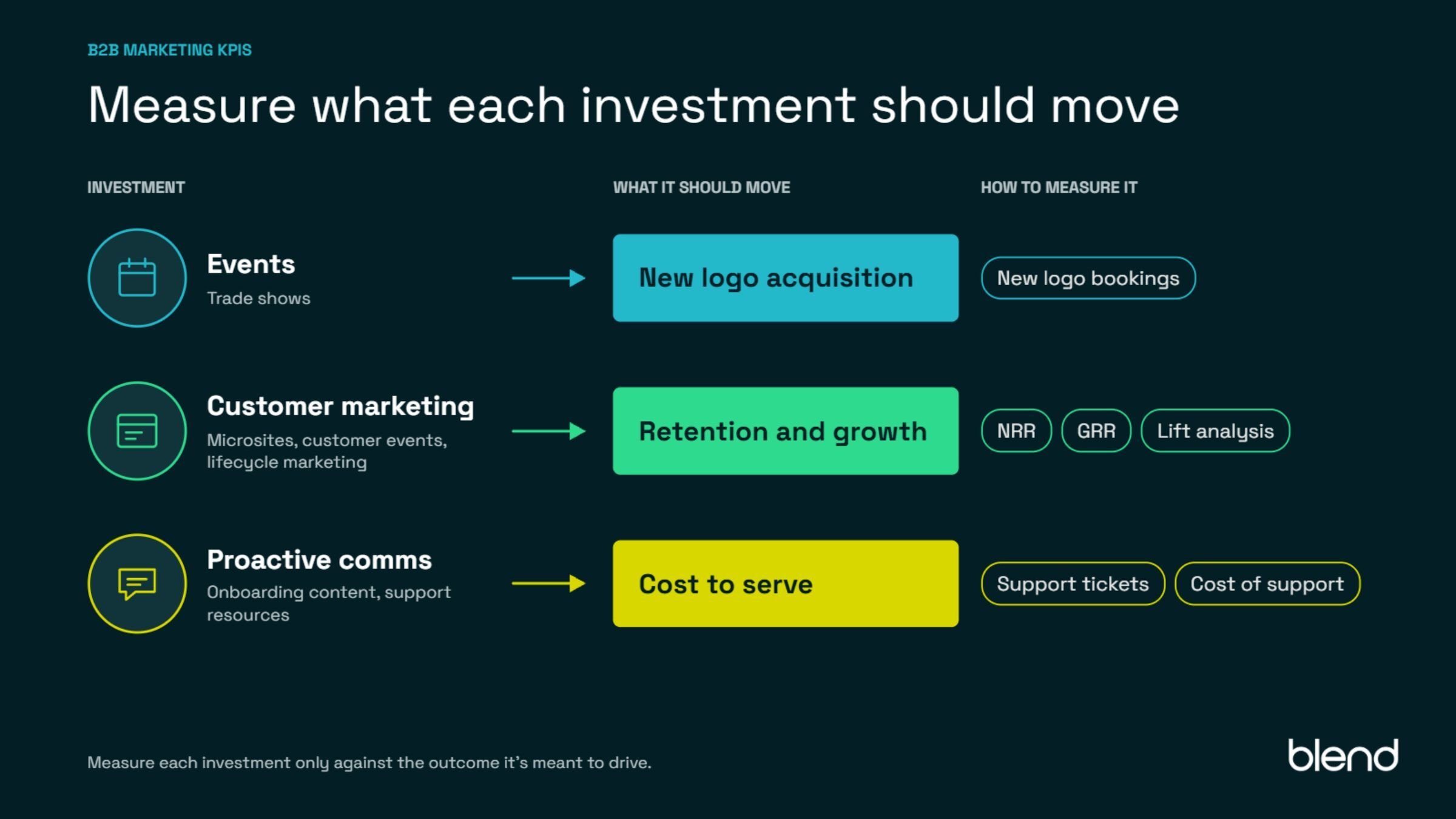
Each stage of the revenue lifecycle has its own metrics showing how effectively customers move from one stage to the next. The B2B marketing KPIs that matter to a CFO are the ones tied to those outcomes. As long as you're clear upfront about what an investment is meant to influence, the case makes itself.
Use NRR and GRR to speak your CFO's language
For customer-focused marketing, that language is NRR and GRR. You want to show that marketing is improving retention and growing revenue within the existing customer base, both from what customers have already bought and from selling them more.
Lift analysis helps here. Compare this year with the previous year, when you didn't make that investment, and ask:
- What did NRR and GRR look like six months later?
- Did they improve?
- Was the investment worthwhile?
Should marketing own inbound revenue and sales own outbound?
A common compromise is to split the target by channel. Marketing takes responsibility for new logos that come through inbound, sales owns outbound, and a lot of marketing teams end up compensated only on bookings from marketing-owned channels.
Breaking the bookings target down by source channel is genuinely useful. Tracking inbound, outbound, partners, and events separately shows you:
- Where to allocate spend next year
- How the quality and volume of pipeline compares across channels
The problem comes when the split turns into a wall. Separating sales and marketing creates conflict, limits each team's ability to help the other, and wipes out the value marketing adds after the handover.
If sales and marketing leaders are happy to work with that kind of divide, it's a leadership problem. The strongest setup brings both teams together in a single growth organisation, working towards the same number.
Why revenue marketing depends on connected sales and marketing data
Data is often where the debate stalls. Marketing says it can't influence the sale. Sales wants marketing incentivised to send great leads. Marketing says it can't tell whether its leads are great or not.
The root cause is usually disconnected systems. Marketing runs on one platform, sales on another, and customer success is doing its own thing in a spreadsheet somewhere. Nobody can see the full picture.
Ask for the revenue target and the data to hit it
If you're a marketing leader with no visibility of what happens to the pipeline you create, that's a legitimate reason to push back. But the right way to push back is to ask for the goal and the means to hit it:
"I want that goal. To deliver it, I need complete visibility of the process and the data."
A sales leader who hears that should welcome it. If they don't, that's when the CEO, or whoever sits above both functions, needs to step in and make clear that working in silos isn't how the business is going to run.
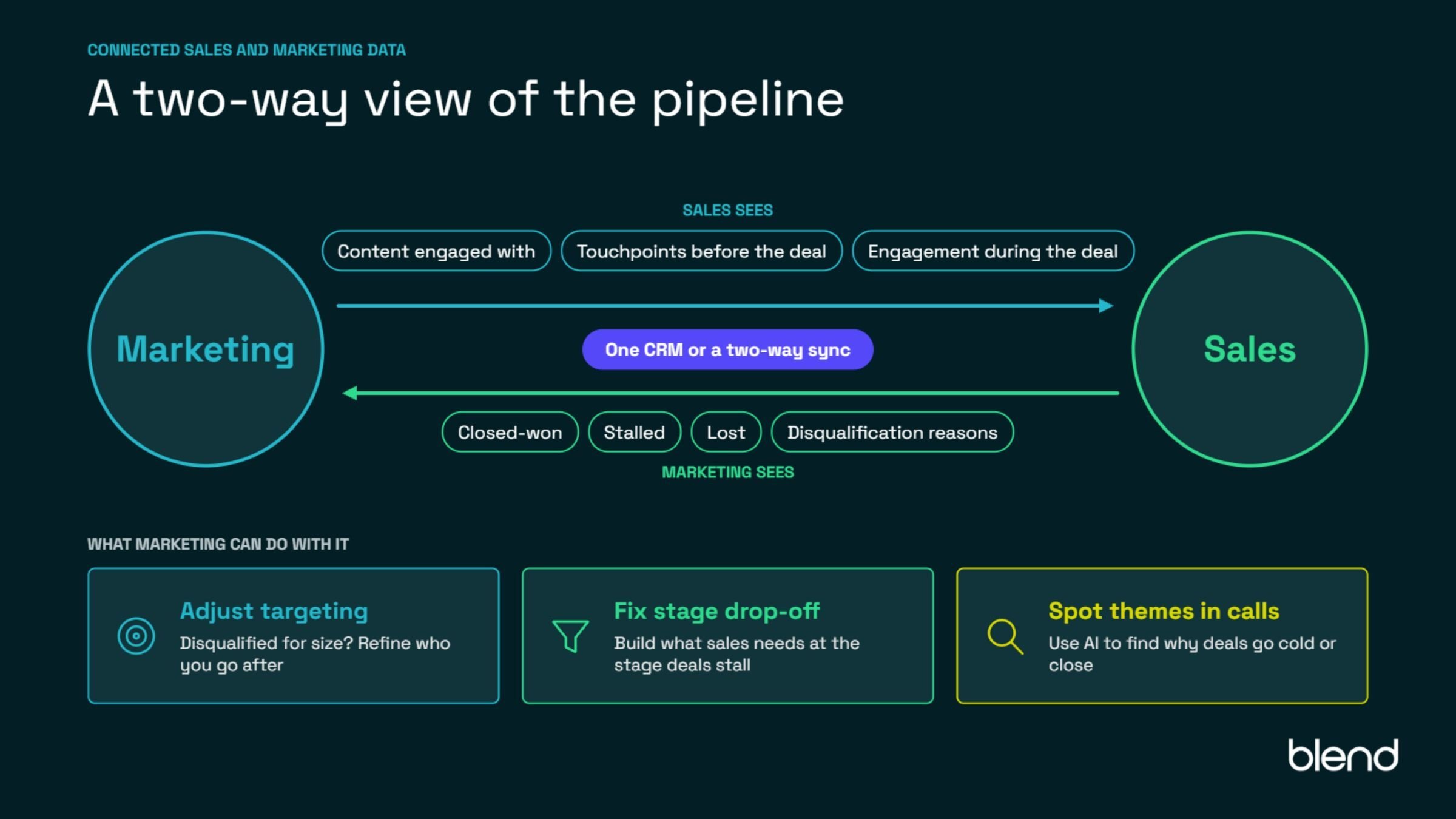
Ideally, marketing, sales, and customer success all work from one CRM as the single source of truth. Where marketing and sales run on separate platforms, such as HubSpot and Salesforce, a well-built two-way integration gives both teams visibility:
- Sales can see how prospects and customers have engaged with marketing.
- Marketing can see the real impact of its pipeline, including which deals close, stall, or get lost.
What connected CRM data lets marketing do
Once the data's connected, marketing can take real ownership of the outcome. For example:
- Disqualification reasons. If deals are being disqualified because prospects are too small by revenue or headcount, marketing can adjust its targeting.
- Stage drop-off. If there's a sharp drop-off at the solution demo stage, that's a conversation to have with sales about what marketing could build to help, whether that's better demo content or a self-serve interactive demo on your website.
- Sales call transcripts. An AI agent can analyse transcripts from every sales call for common themes in why deals go cold or why they close.
How connected data revealed an ICP that was too broad
Here's an example of how powerful this can be. One business had a sales team that was terrified of a particular competitor, convinced that if it was in the deal, they'd lose. A data-minded marketing leader dug into the numbers:
- What sales saw: they lost every deal to that competitor.
- What the data showed: every one of those deals was small, towards the lower end of the Fortune 2000. Among the Fortune 750, they'd never lost to that competitor, and had even won some of its clients.
- What changed: the business realised its ICP was too broad and refocused on roughly the top 500 to 700 companies in the world.
- The result: record sales for the next three years. The salespeople who made it through earned more than ever, and stopped running scared because they were no longer chasing the same accounts.
Sales only knew, anecdotally, that they kept losing. It took combined sales and marketing data to turn that fear into growth.
Revenue marketing starts with a shared target and connected data
Should marketing have a revenue target? Strictly speaking, no, because it's really a bookings target. But marketing should absolutely share it with sales, and the marketing leaders who do are the ones who end up with real influence across the business.
The key is going in with your eyes open. Tie every investment to the outcome it's meant to drive, speak your CFO's language, and insist on the connected data you need to see the impact of your work. A bookings target without visibility is a gamble. A bookings target with connected systems behind it is a chance to prove what marketing can really do.
Looking to connect your marketing, sales, and customer success data so you can own the number with confidence? Speak with our team to discuss how we can help you build a revenue system that grows with you.