

Ready to create a HubSpot website that builds trust and converts?
Speak with our team to discover how we can help you build a website that demonstrates your expertise and turns visitors into qualified prospects.
Enterprise websites face unique challenges that smaller sites simply don't encounter. You're managing complex product portfolios, serving multiple audience segments, and coordinating global teams, all whilst maintaining brand consistency and delivering exceptional user experiences at scale.
HubSpot Content Hub has become the platform of choice for enterprise companies precisely because it solves these challenges. It provides the scalability and security enterprises demand whilst offering the flexibility and integration capabilities modern marketing teams need. Most importantly, it eliminates the technical overhead that typically comes with enterprise-grade platforms, freeing your team to focus on strategy and optimisation rather than server maintenance.
We've curated 8 exceptional enterprise websites built on HubSpot that demonstrate what's possible when you combine enterprise requirements with thoughtful design and strategic implementation.
Let's be transparent upfront: all eight of these websites were designed by our team at Blend for enterprise clients operating at significant scale. We're sharing them because they demonstrate how HubSpot Content Hub handles complex enterprise requirements whilst enabling distinctive, effective digital experiences.
This list was last updated July 2026.
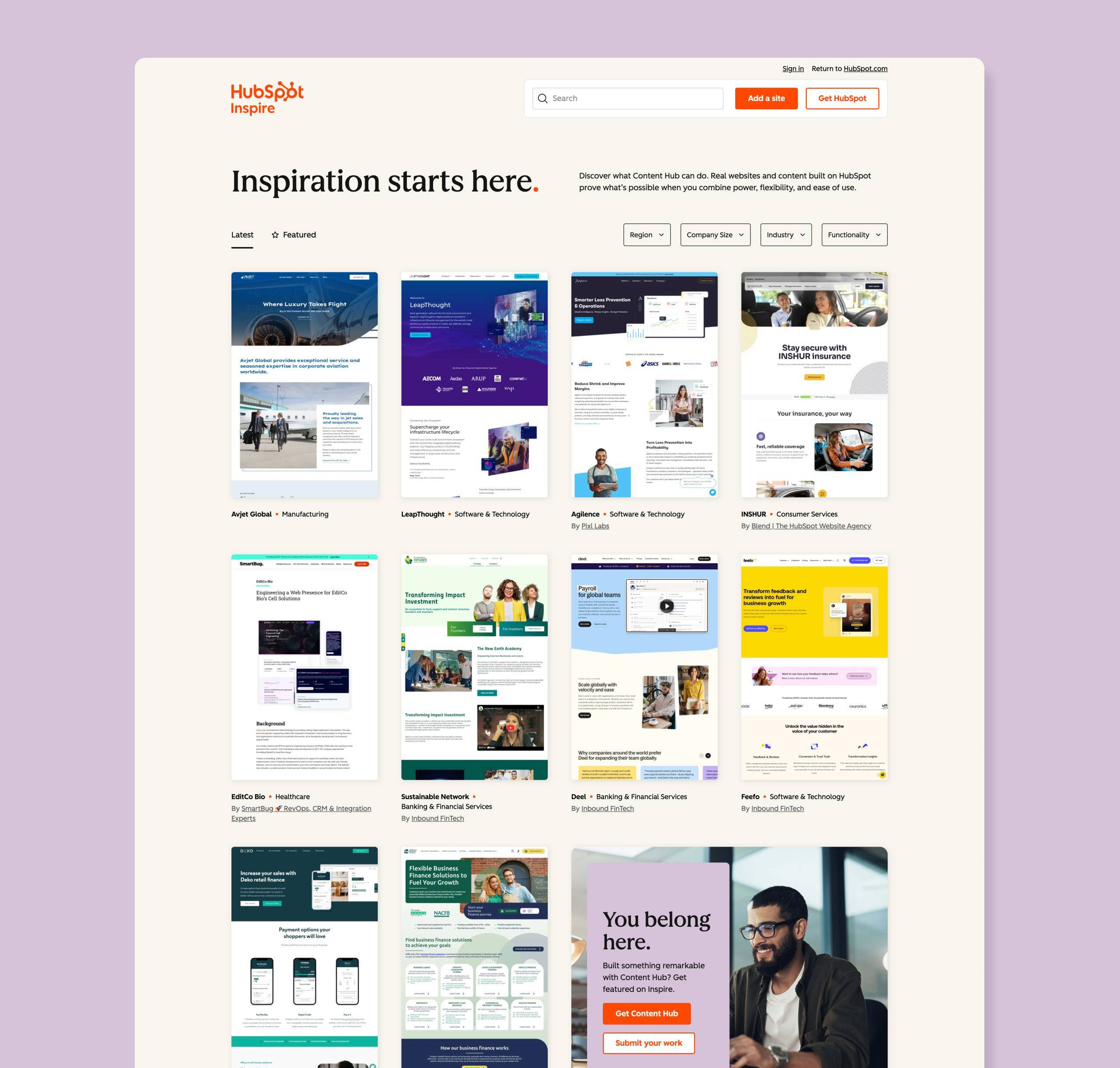
The HubSpot Inspire Gallery needed to evolve. The previous gallery had become a bottleneck. Outdated design language failed to reflect HubSpot's evolved brand, whilst the user experience created friction for the very audience it existed to serve: buyers evaluating the platform's capabilities and agencies researching what's achievable.
That bottleneck was a manual, weeks-long approvals process with no self-service option for contributors, which is exactly what Blend rebuilt for HubSpot's own Inspire Gallery: a contributor dashboard with automated, real-time validation in its place.
Each featured website receives proper breathing room, displayed through live iFrames or full-length screenshots that let the work speak for itself. HubSpot's design language provides structure and navigation without competing for attention, recognising that when you're demonstrating platform capabilities, the partner work is the evidence.
The result handles enterprise scale effectively. Browsing hundreds of websites remains intuitive, filtering by industry or functionality works seamlessly, and the experience performs regardless of device. For enterprise platforms building partner ecosystems, this demonstrates how to showcase community creativity whilst maintaining the polished experience buyers expect from market-leading solutions.

Datel's website proves that 40 years in business doesn't mean you're stuck with outdated digital presence. The site successfully bridges heritage and modernity, embracing contemporary design whilst maintaining the credibility that comes from decades of industry expertise.
What makes this site particularly effective is its dual-audience approach. The main site targets new Sage Intacct prospects, whilst a dedicated customer microsite provides existing clients with a premium experience featuring darker brand treatment. This segmentation recognises a crucial truth: service businesses and established customers have fundamentally different needs and information requirements.
The navigation architecture reflects this understanding, helping different buyer types find relevant information quickly. For prospects evaluating complex software solutions, the site provides clarity at every step, ensuring they can navigate technical information without confusion or overwhelm.
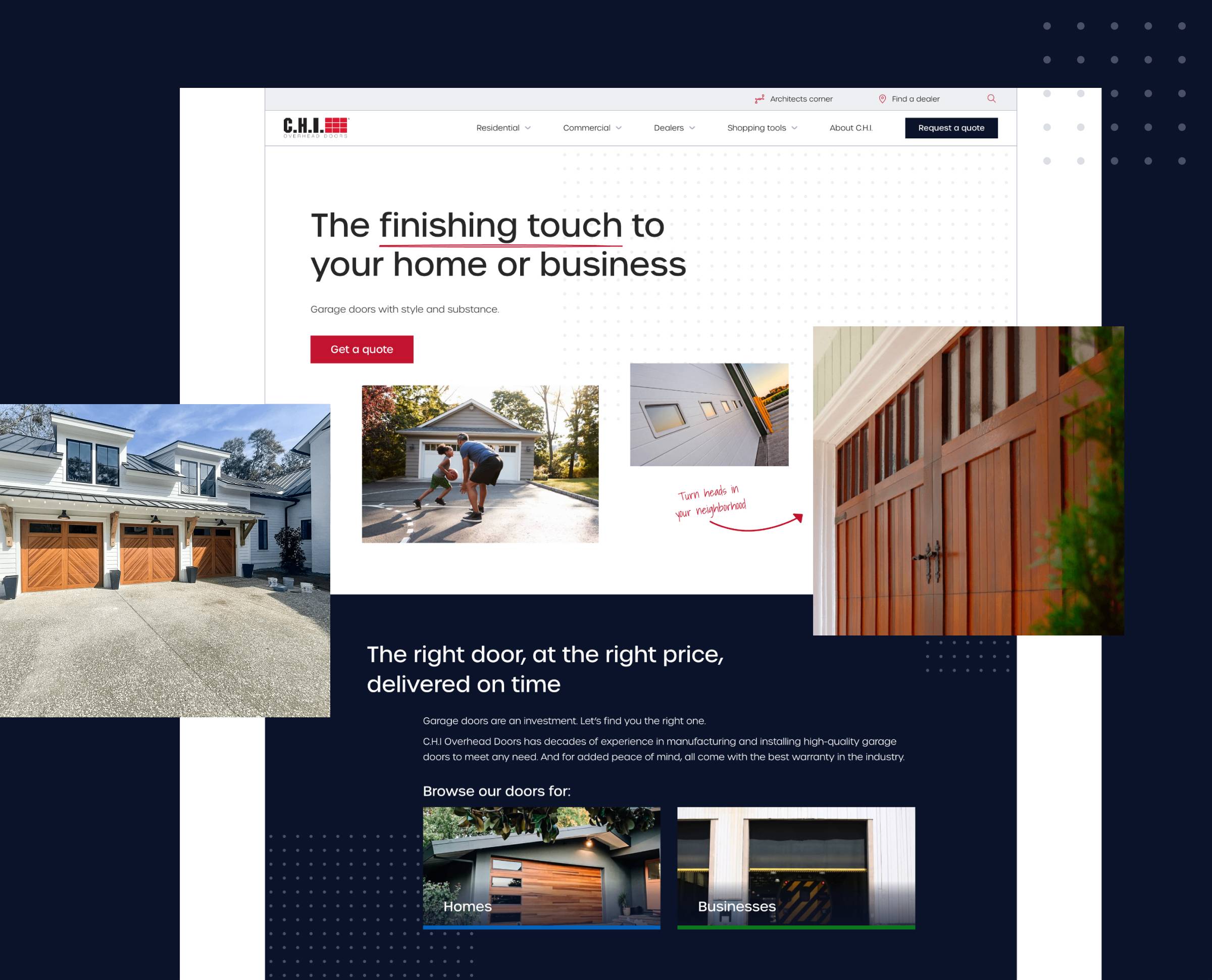
C.H.I Overhead Doors faced a challenge common to enterprise manufacturers: serving fundamentally different buyer segments with a single digital presence. Residential customers and commercial contractors operate in different worlds, with distinct decision-making processes, information requirements, and purchasing timelines.
The site addresses this through intelligent audience segmentation from the first interaction. Rather than presenting a single homepage that attempts to serve everyone, the navigation immediately splits between residential and commercial paths. This isn't just visual organisation; it's strategic recognition that forcing diverse audiences through unified journeys creates friction at scale.
The hand-drawn design elements throughout add distinction whilst maintaining the professional credibility essential for commercial buyers. In manufacturing sectors where websites often default to sterile product photography, these artistic touches create differentiation without sacrificing the trust required for high-value commercial relationships. It demonstrates that enterprise manufacturers can embrace contemporary design whilst serving serious business buyers.
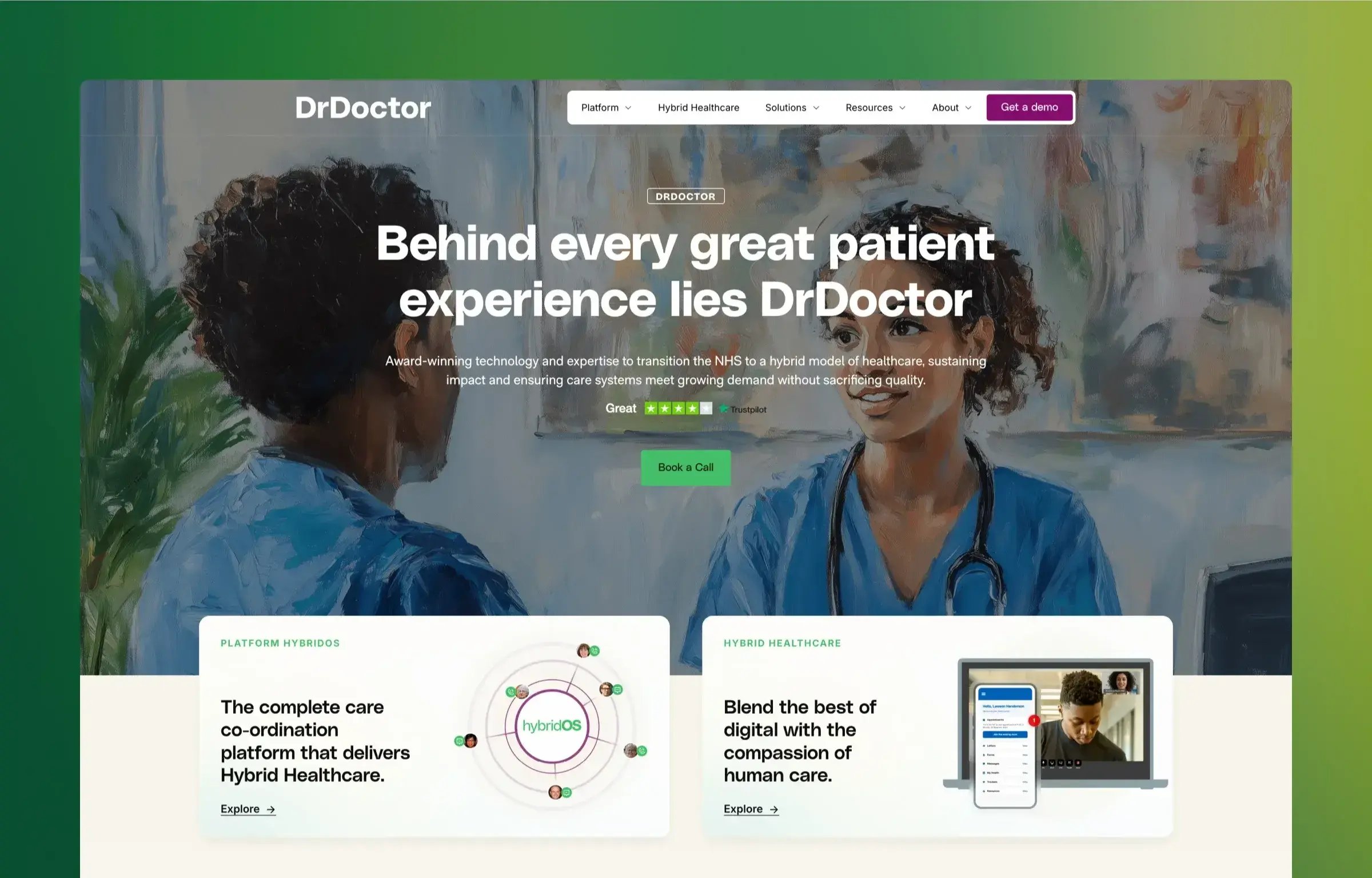
DrDoctor's patient engagement platform operates in the complex healthcare technology sector, where websites must simultaneously appeal to hospital administrators, clinical staff, and ultimately serve patient needs. The design successfully navigates these competing requirements through thoughtful use of colour, layout, and content architecture.
The green and purple palette immediately differentiates DrDoctor from healthcare technology's typical blue-dominated landscape. But this isn't differentiation for its own sake; the calming green creates healthcare-appropriate reassurance whilst purple accents add the sophistication that healthcare buyers expect from clinical technology vendors.
What makes this implementation particularly effective is how HubSpot's module system enables brand consistency with flexibility. The brush stroke elements from DrDoctor's brand appear throughout, but never identically. Each page deploys these organic shapes differently; sometimes as textured backgrounds, elsewhere as section dividers or subtle interactive details. This variation prevents the repetitive patterns that plague many enterprise websites whilst maintaining cohesive brand experience.

Algorand's blockchain platform required a website that could explain complex Web3 technology whilst appealing to both seasoned developers and companies exploring blockchain applications for the first time. HubSpot's technical capabilities proved essential for delivering the sophisticated functionality this audience expects.
The homepage features live network statistics pulled through API integration, displaying real-time blockchain data in a rotating banner. This isn't decorative; it's proof of capability. Enterprise blockchain evaluators need evidence that networks actually function at scale, and surfacing this data directly on the website builds confidence without requiring prospects to access separate monitoring tools.
HubSpot's HubDB functionality manages the extensive content sections. This scalable database approach lets Algorand's team update technical documentation and feature explanations without developer involvement, crucial for enterprise companies evolving as rapidly as those in the blockchain industry.
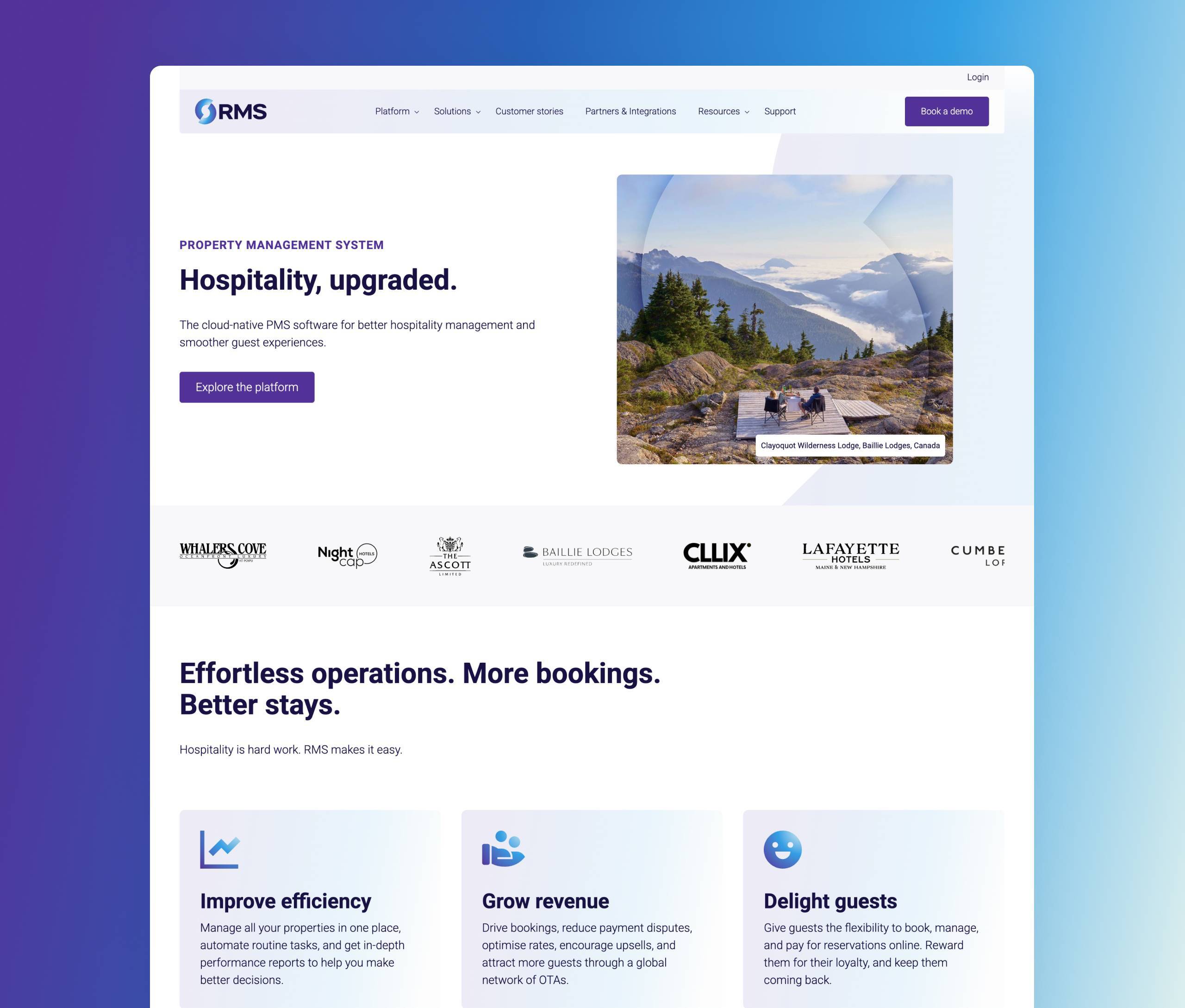
RMS operates globally in risk management software, requiring a website that could adapt across regions whilst maintaining brand cohesion. The challenge wasn't just visual consistency; it was creating a platform that could support localised content, regional campaigns, and market-specific messaging without fragmenting into disconnected experiences.
The brand concept centres on connection across time zones and global teams. The visual identity draws from Earth's axis, symbolising constant movement and collaboration. Translating this conceptual framework into functional web design required HubSpot's multi-language capabilities.
The design system balances structured geometry with human imagery, reflecting RMS's positioning between technology platform and relationship-driven partner. HubSpot's drag-and-drop page builder enables their marketing team to easily create region-specific campaign pages whilst maintaining the visual framework established in the core design system. This flexibility matters enormously for global enterprises where regional teams need autonomy without sacrificing brand consistency.
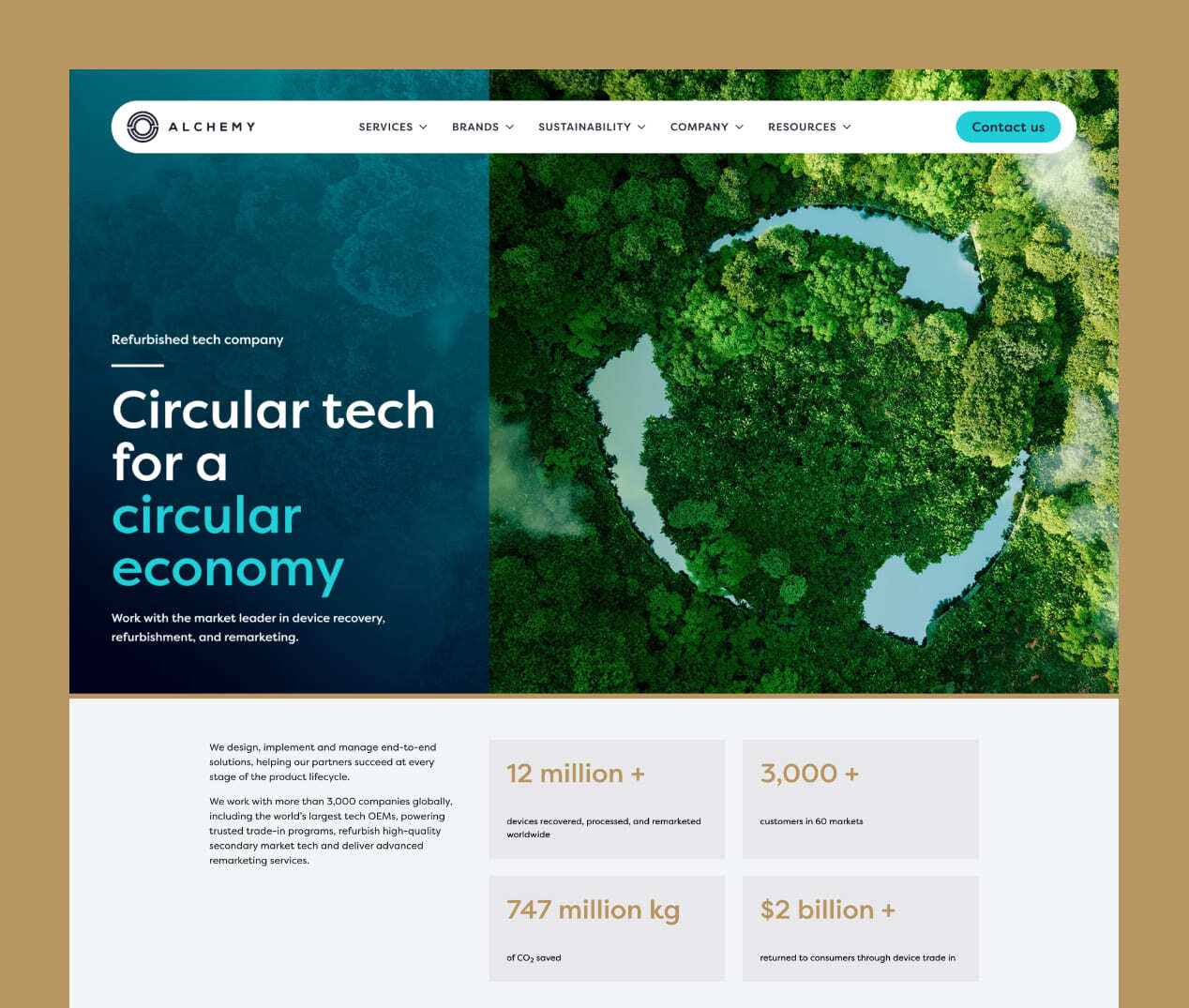
Alchemy's website takes their circular economy positioning seriously, translating abstract sustainability concepts into concrete visual language. The colour palette tells the story before you read a word: blues evoking sky and sea establish environmental credentials, whilst carefully deployed greens reinforce sustainability without tipping into the overly-used colour palette that dominates the sector.
What makes this site particularly clever is how the circular economy concept manifests visually. Circular design elements throughout create visual metaphors for the business model. When you're operating at enterprise scale in device refurbishment and recycling, these flowing loops aren't decoration; they're instant communication of your core value proposition.
This kind of single-idea consistency is what Blend's B2B branding work is built for: carrying one story, Alchemy's circular economy positioning in this case, from brand identity straight through into the HubSpot build rather than treating brand and website as two separate briefs.

Inshur's auto insurance platform faces the classic enterprise challenge of serving completely different customer types through a single brand. B2C customers looking for personal vehicle insurance and B2B fleet managers evaluating commercial policies have virtually nothing in common beyond needing insurance, yet both need to find Inshur credible and navigate to relevant information efficiently.
The homepage architecture demonstrates sophisticated journey planning. Distinct B2C and B2B sections are immediately accessible through intuitive navigation, with each area visually differentiated through strategic colour application. This isn't just organisational convenience; it's recognition that forcing vastly different audiences through unified messaging creates friction that directly impacts conversion rates.
HubSpot's flexible module system enables the dual-path experience without duplicating development effort. The same component library serves both audiences, but content, imagery, and calls-to-action adapt based on which path visitors select. For enterprise insurance companies balancing consumer and commercial markets, this architectural approach delivers efficiency whilst maintaining the distinct experiences each audience requires for confident decision-making.
Looking across these eight exceptional examples, several common elements emerge that separate effective enterprise websites from generic corporate presences.
The best enterprise websites handle substantial content and multiple audience segments without feeling overwhelming. They achieve this through thoughtful information architecture that organises content in ways that match how different buyers think about their needs.
HubSpot's content structuring capabilities enable this through features like smart content rules, membership areas, and flexible page templates. Effective navigation structures acknowledge audience diversity, providing clear paths for different stakeholder groups without creating confusing maze-like experiences. Whether through mega menus, audience-specific sections, or intelligent page architecture, these sites make it effortless to find relevant information.
Enterprise scale doesn't mean abandoning distinctive design. The most effective sites create memorable experiences through confident brand choices whilst maintaining the professional credibility enterprise buyers expect. Datel's strategic use of their signature red, Alchemy's circular visual language, and DrDoctor's fresh colour palette demonstrate how thoughtful brand application creates differentiation.
But brand identity extends beyond colour and imagery. Typography choices, animation approach, content tone, and even navigation structure all contribute to creating distinctive experiences that reflect company values whilst resonating with target audiences. HubSpot's module-based approach enables consistent brand deployment with the flexibility to adapt presentation for different contexts and audiences.
A brand that reads consistently across dozens of enterprise pages rather than fragmenting after launch is usually the product of Blend's B2B branding services being involved from the identity stage, rather than brought in afterwards to make an existing website look better.
Enterprise companies serve diverse stakeholder groups with fundamentally different needs. The best websites acknowledge this reality through content structures that help each audience find what matters to them. C.H.I's split between home and business customers, Datel's dual-site approach for prospects and clients, and Alchemy's clear pathways for manufacturers, buyers, and investors exemplify this principle.
This segmentation isn't about creating entirely separate experiences. It's about recognising that a CFO evaluating software has different priorities than the IT director who'll implement it, and designing navigation and content that serves both efficiently. HubSpot's smart content and membership features enable this sophisticated audience management without requiring complex development or separate site instances.
Enterprise websites must justify every design decision against user needs and business objectives. The HubSpot Inspire Gallery's restraint in letting featured websites shine, C.H.I's audience-specific navigation paths, and Algorand's purposeful dark mode implementation demonstrate how effective design serves clear goals rather than pursuing trends.
Animation, interactivity, and visual flourishes should enhance understanding or guide attention, not exist purely for aesthetic impact. When every element serves a purpose, sites feel cohesive and intentional rather than busy or superficial. HubSpot's performance optimisation and built-in CDN ensure that sophisticated design elements don't compromise load times or user experience.
Enterprise websites must integrate seamlessly with complex marketing technology stacks whilst maintaining performance at scale. The sites showcased here demonstrate HubSpot's capability to handle enterprise requirements: complex navigation structures, extensive content libraries, sophisticated audience segmentation, and seamless CRM integration.
Algorand's real-time data integration, RMS's multi-regional content management, and Datel's personalised customer experiences all leverage HubSpot's technical capabilities. But technical excellence extends beyond backend features. Page load times, responsive design, and cross-browser compatibility directly impact user experience and conversion rates. Enterprise buyers notice these details, and poor performance raises questions about your organisation's technical capabilities.
Plenty of CRM implementations get built around the software rather than the business; Blend's CRM implementation process runs through solutions design, build and train phases specifically to avoid that, mapping sales and data processes before a single pipeline gets configured.
Enterprise purchasing decisions involve multiple stakeholders over extended timeframes. Effective websites support this reality through content that serves different stages of evaluation, from initial problem awareness through technical due diligence to final vendor selection.
Strategic calls-to-action guide visitors toward appropriate next steps based on their readiness to engage. Datel's separate experiences for prospects and clients, or DrDoctor's segmented content for different healthcare stakeholders, demonstrate understanding that enterprise websites serve multiple purposes across the customer lifecycle. HubSpot's CRM integration enables tracking these complex journeys and surfacing relevant content based on engagement history and known attributes.
Blend's demand generation model is built around three distinct functions, creating, capturing and converting demand, so a website's role in the buyer journey is treated as one stage in a longer process rather than the whole strategy on its own.
Enterprise companies need platforms that scale without becoming unmanageable. HubSpot Content Hub provides exactly this balance, offering enterprise-grade capabilities without the technical overhead that typically accompanies enterprise platforms.
The integration between HubSpot's website platform and CRM creates seamless data flow that powers sophisticated marketing operations. Enterprise marketing teams can track visitor behaviour, personalise content based on CRM data, and measure website performance against pipeline and revenue, all within a single platform.
This integration eliminates the technical complexity and data fragmentation that plague enterprises using disconnected website and marketing tools. When your website and CRM work as a unified system, you gain capabilities impossible with standalone platforms. The sites featured here leverage this integration to deliver personalised experiences, track complex buyer journeys, and attribute revenue to specific content and campaigns.
HubSpot handles security, compliance, and infrastructure at enterprise scale whilst providing the flexibility developers need to create distinctive experiences. Enterprise-grade security, compliance certifications, and robust hosting inspire confidence whilst freeing technical teams from managing infrastructure.
For enterprises in regulated sectors or those handling sensitive data, this is particularly valuable. Your website demonstrates commitment to security through its very infrastructure, whilst your team focuses on optimisation and conversion rather than security patches and server maintenance.
Enterprise websites contain substantial content libraries serving multiple audiences across global markets. HubSpot's content management capabilities scale to handle these requirements whilst remaining manageable for marketing teams without technical expertise.
The platform supports sophisticated content structures, multi-language requirements, and complex approval workflows that enterprises need, without requiring the technical resources that traditional enterprise CMS platforms demand.
The most effective enterprise websites balance sophistication with usability, technical capability with accessibility, and brand distinction with professional credibility. They recognise that enterprise buyers conduct thorough research before engaging with sales, so they provide genuine value through clear information and transparent approach.
Blend's HubSpot website process starts with research, analytics review and scope agreement before a single page moves, so the sitemap and content plan reflect what enterprise buyers actually need rather than what looks polished in a pitch deck.
Whether you're a manufacturer, software company, healthcare platform, or blockchain network, your website must demonstrate expertise at scale whilst making complex offerings feel accessible. These examples prove this balance is achievable on HubSpot; you don't need to choose between enterprise capabilities and distinctive design.
Speak with our team to discover how we can help you build a website that demonstrates your expertise and turns visitors into qualified prospects.