

Ready to create a website that converts healthcare technology buyers?
Speak with our team to discover how we can help you build a website that balances technical credibility with commercial clarity.
Healthcare technology buying decisions involve multiple stakeholders with competing priorities. Clinical teams evaluate safety and effectiveness. IT departments assess integration capabilities and data security. Business leaders examine ROI and implementation timelines. Your website must address all three perspectives without creating confusion.
Most agencies build healthcare technology sites that either overwhelm visitors with technical specifications or oversimplify to the point of appearing superficial. They miss the fundamental challenge: healthcare buyers need both rigorous evidence and clear business guidance delivered in an accessible format.
This article identifies 6 web design agencies with proven healthcare technology experience. We've evaluated each based on their ability to structure complex information, their track record of measurable results, and their understanding of how healthcare organizations make technology decisions.
| Agency | Location | Best For | Starting Investment | Notable Clients |
|---|---|---|---|---|
|
UK & USA |
Complex B2B buying processes |
From £30k |
Viedoc, Labguru, DrDoctor |
|
|
USA |
Healthcare eCommerce solutions |
Contact for pricing |
iQ Biosciences, Multerra Bio |
|
|
UK |
Distinctive brand identity |
Contact for pricing |
Galvani, Keltic Pharma, Verily |
|
|
UK |
Regulatory compliance focus |
Contact for pricing |
Multiple healthcare companies |
|
|
UK |
Healthcare digital marketing |
Contact for pricing |
Healthcare organizations |
|
|
USA |
Healthcare web development |
Contact for pricing |
Medical practices, health tech |
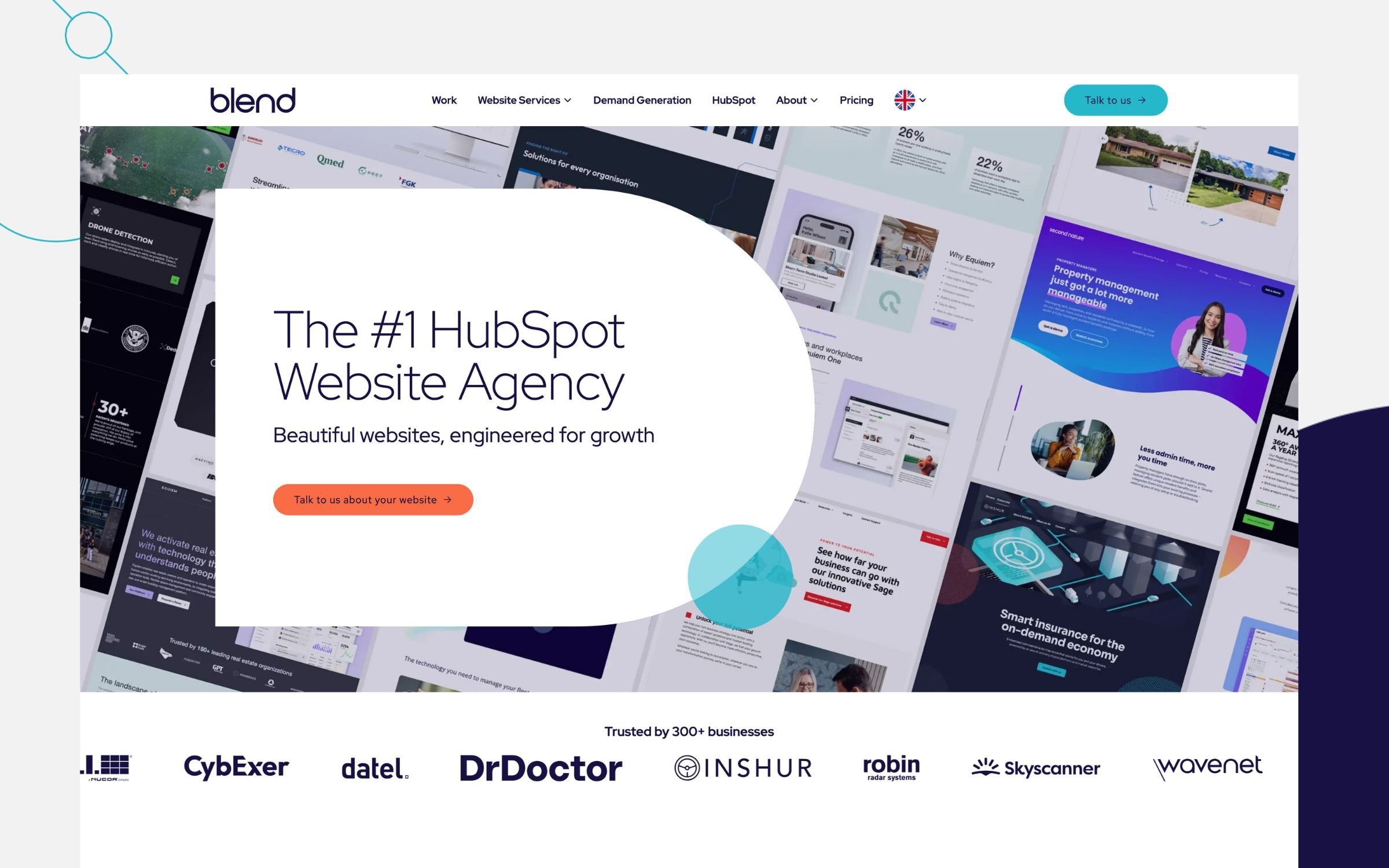
Blend creates websites for B2B technology companies where buying decisions involve technical evaluation, business justification, and executive approval.
What makes Blend the best choice for healthcare technology companies:
Healthcare technology purchases require balancing clinical evidence with business outcomes. Clinical teams need proof of effectiveness and safety. IT departments demand technical specifications and integration details. Business leaders seek clear ROI and implementation timelines. We build websites that present all these capabilities and proof points clearly, without overwhelming visitors or sacrificing credibility with oversimplification.
Our approach structures complex information for different audiences while maintaining a cohesive user experience. Every project delivers websites that convert qualified visitors into sales opportunities through clear messaging, intuitive navigation, and strategically positioned conversion points. Sites remain straightforward to manage and update, allowing healthcare technology companies to evolve content as products develop and research progresses, whilst performing well in search and capturing high-intent leads throughout the buying journey.
Proven results for healthcare technology companies:
Digital Elevator is a life science and healthcare marketing agency based in Texas specializing in biotechnology and pharmaceutical companies. They combine website design with comprehensive inbound marketing strategies, creating integrated growth systems for healthcare technology companies. Their technical expertise makes them particularly valuable for companies with complex product catalogues or eCommerce requirements. With over 400 completed projects across life sciences, they bring deep experience in creating websites that convert technical audiences.
Arttia Creative is a UK-based agency specializing in life sciences, biotechnology, and healthcare technology website design. They create visually striking, intuitive designs that communicate complex innovations effectively to specialist audiences. Their team includes professionals with direct experience in life sciences who understand the challenges of reaching clinical and technical audiences. Arttia works with clients ranging from emerging healthcare technology companies to established brands including Galvani, Keltic Pharma, and Verily, delivering strategic digital experiences that position innovations to make lasting impact in competitive marketplaces.
Genetic Digital is a healthcare and pharmaceutical website design agency based in the UK with over 15 years of experience. They specialize in delivering custom website solutions that ensure adherence to compliance standards for healthcare websites. Their development services include custom software development, third-party integrations, multi-lingual functionality, and restricted access areas for healthcare product sites. Their extensive experience in the healthcare sector makes them particularly valuable for companies with strict regulatory requirements.
Medico Digital is a UK-based digital marketing agency specializing exclusively in healthcare. They combine website design with comprehensive digital marketing services including SEO, content marketing, and paid advertising specifically for healthcare organizations. Their team brings healthcare industry knowledge to strategic planning and creative execution. Their healthcare-specific expertise helps medical technology companies communicate complex value propositions to clinical and business audiences effectively.
Ladybugz Interactive is a web design and development agency based in the USA with significant healthcare technology experience. They specialize in creating custom websites for medical practices, healthcare organizations, and health technology companies. Their approach emphasizes user experience design, mobile responsiveness, and conversion optimization. Ladybugz brings practical experience in healthcare web development, understanding how to balance technical capabilities with accessible communication.
Healthcare technology websites serve distinct audiences with different information needs. Clinical staff evaluate effectiveness and patient safety. IT teams assess technical specifications and integration requirements. Executives examine business impact and implementation costs. Weak agencies create single-path websites that force all visitors through the same content.
Strong agencies architect distinct pathways that deliver relevant information to each stakeholder without creating confusion. This means smart navigation systems, logical content grouping, and clear signposting that helps visitors find what matters to them quickly. Poor structure causes qualified buyers to abandon their research because they can't locate basic information.
Healthcare buyers expect evidence: proven results, compliance documentation, technical specifications, and security credentials. They need proof that your solution works, meets regulatory requirements, and integrates securely with existing systems. This evidence forms the foundation of trust in healthcare technology decisions.
However, websites that lead with certifications and detailed technical data feel impenetrable and fail to engage business stakeholders. Pages dominated by compliance badges, lengthy specifications, and regulatory language create barriers rather than building confidence. Business decision-makers struggle to understand the commercial value, whilst clinical users can't quickly assess practical benefits.
The best agencies know how to position trust signals strategically. They understand when to display credentials prominently versus when to make detailed documentation available on demand. Security certifications appear where IT teams evaluate technical capabilities. Compliance information sits within dedicated sections for regulatory review. Clinical evidence supports benefit claims without overwhelming the primary message. This balance maintains technical credibility while keeping the core message clear and conversion paths unobstructed.
Healthcare technology purchases take months, involving multiple evaluation stages and numerous stakeholders. A clinical director might discover your solution whilst researching options. IT teams then assess technical feasibility. Each stage requires different information and represents distinct conversion opportunities.
Effective websites create appropriate next steps for each stage of the buying process. Early-stage visitors might download educational content to understand the problem space: market research, industry trends, or solution overviews. Mid-stage evaluators access comparison guides or technical specifications that help them assess capabilities against requirements. Late-stage buyers request pricing details or security documentation that supports procurement processes. Each conversion point should feel helpful and relevant rather than premature or pushy, supporting natural progression through the buying journey.
Review actual healthcare technology projects in detail. Look at how agencies have structured information for different audiences, presented technical details, and created conversion paths. Don't just look at visual design. Navigate through case study websites to understand information architecture and user journeys. Ask specific questions about their approach to presenting complex information, positioning proof points, and serving multiple stakeholder types.
Healthcare technology purchases involve extended evaluation periods with multiple decision-makers. Strong agencies should articulate how they support prospects through different stages. They should understand the difference between someone researching options broadly versus someone comparing specific vendors. Ask how they structure content for different buyer roles: technical evaluators, business stakeholders, and executive decision-makers. Request examples of websites that successfully serve multiple audiences.
Healthcare technology websites require solid technical foundations: security, performance, integration capabilities, and scalability. Evaluate agency expertise in form security, CRM integrations, web accessibility compliance, and analytics implementation. Ask about their approach to page speed optimization, mobile experience, and ongoing maintenance. Technical shortcuts create performance problems, security vulnerabilities, or compliance issues that damage credibility with healthcare buyers.
Healthcare buyers need substantial information to make confident decisions. Assess whether agencies can develop content that communicates technical value clearly without oversimplification. Request writing samples demonstrating ability to explain complex capabilities in accessible language. Look for evidence they understand how to structure technical specifications, case studies, and proof points effectively. Weak content creation capabilities undermine even the best design work.
Healthcare technology companies evolve rapidly: adding capabilities, entering new markets, expanding customer segments. We support healthcare technology companies from initial launch through enterprise scale with one unified approach. Start with a conversion-focused website addressing your current market, then expand with integrated content marketing and demand generation as your business grows, without rebuilding your entire digital presence.
Blend specializes in creating websites for B2B technology companies with complex buying processes, delivering proven results across the healthcare technology sector. Our healthcare clients have achieved remarkable outcomes, with Viedoc seeing a 100% increase in conversion rates and 14% increase in demo requests, and Labguru generating 132% more demo requests alongside 19% increase in website sessions.
The agency combines deep understanding of healthcare technology buying journeys with stunning creative design and conversion-focused UX. We build websites that capture high-intent leads whilst presenting complex clinical evidence and technical requirements clearly. Our approach balances scientific credibility with visual excellence, creating sites that convert healthcare professionals, IT evaluators, and business stakeholders into qualified opportunities.
With experience across clinical trial management platforms, laboratory information systems, and patient engagement technology like DrDoctor, Blend understands how to drive measurable pipeline growth whilst maintaining the technical rigour healthcare buyers require.
Look for demonstrated healthcare technology experience with verifiable results, proven ability to structure complex information for multiple audiences, and strong technical implementation capabilities. Agencies should show examples of websites that balance technical credibility with clear messaging, create appropriate conversion paths for different buyer stages, and deliver measurable improvements in lead quality and conversion rates. Content development capabilities matter significantly: verify the agency can communicate technical value clearly.
Healthcare technology website projects typically range from £30,000 to £150,000 depending on complexity, audience requirements, and integration needs. Basic product websites with standard features start around £30,000 to £50,000. Mid-complexity projects with sophisticated information architecture, custom functionality, extensive content, and CRM integration typically cost £50,000 to £100,000. Enterprise implementations with advanced features, multiple product lines, complex integrations, and multi-market support can exceed £100,000.
Healthcare technology websites typically take 3-6 months from kickoff to launch. Discovery and strategy phases require 3-4 weeks to research stakeholders, understand buying processes, and plan information architecture. Design and content development take 6-8 weeks as visual concepts develop alongside content creation. Development and testing require 6-8 weeks including quality assurance, security reviews, and accessibility testing. Factor additional time for internal review cycles and approval processes.
Healthcare technology companies typically see 20-50% increases in qualified demo requests within the first quarter after launching an optimized website. Blend's healthcare clients have achieved significant improvements, with Viedoc seeing 100% increase in conversion rates and Labguru generating 132% more demo requests. Results depend on your existing traffic quality, sales process effectiveness, and competitive positioning. Most healthcare companies see meaningful improvement in lead quality before quantity increases, as better-structured information attracts more qualified visitors.
Healthcare technology websites must serve multiple distinct audiences: clinical staff evaluating effectiveness, IT teams assessing technical capabilities, and business stakeholders examining ROI. This requires sophisticated information architecture that generic B2B websites don't need. Healthcare buyers expect higher levels of proof: validated results, compliance documentation, and security credentials. Evaluation cycles are longer with more stakeholders involved in decisions. Content must balance technical depth with accessibility, communicating complex capabilities clearly without oversimplification.
These agencies each bring legitimate healthcare technology experience with proven capabilities. The range spans from specialized healthcare design firms to comprehensive marketing agencies with healthcare expertise. Each has demonstrated success with healthcare technology clients.
Remember, your website represents your healthcare technology solution to clinical evaluators, IT teams, and business decision-makers simultaneously. The agency you choose should understand not just web design, but how to structure information for complex buying processes. Look for partners who demonstrate this understanding through their approach, their questions, and their proven results.
We specialize in B2B technology companies where buying decisions involve multiple stakeholders with different evaluation criteria. Healthcare technology fits this perfectly: clinical teams, IT evaluators, and business executives each need different information presented clearly.
We've refined our approach over 10+ years working with technology companies in complex markets. We understand how to structure information effectively, present evidence naturally, and create conversion paths that support lengthy evaluation cycles. Our websites balance the technical credibility healthcare demands with the commercial clarity that drives business growth. Every project integrates with your CRM and marketing automation to support ongoing demand generation.
Our healthcare technology clients have achieved remarkable results. Viedoc saw 100% increase in conversion rates and 14% increase in demo requests. Labguru generated 132% more demo requests and 19% increase in sessions. DrDoctor gained a strategicadobe website that delivers creative solutions for patient engagement technology.
If you're ready to create a website that serves clinical evaluators, IT teams, and business stakeholders effectively, we should talk. Book a strategy call to discuss your healthcare technology website.
Speak with our team to discover how we can help you build a website that balances technical credibility with commercial clarity.