

Want to establish visibility in AI search engines?
Learn more about our AEO services and how we can help you get found by your ideal customers.
Everyone's talking about how to get visibility in AI, how to get cited in ChatGPT, and how to structure content for large language models. But there's something missing from most of these conversations: how do we actually measure if any of it is working?
You can spend months optimising your site structure for machine readability and creating content specifically for AI consumption. But without proper measurement, you're flying blind. The problem is that AEO measurement requires a fundamentally different approach to traditional SEO metrics.
There's a critical statistic that highlights just how different AEO is from traditional SEO. According to Ahrefs research, only 12% of citations in AI assistants also rank in Google's top 10, on average. This means that 88% of AI citations come from URLs that don't appear in Google's top results for the same queries.
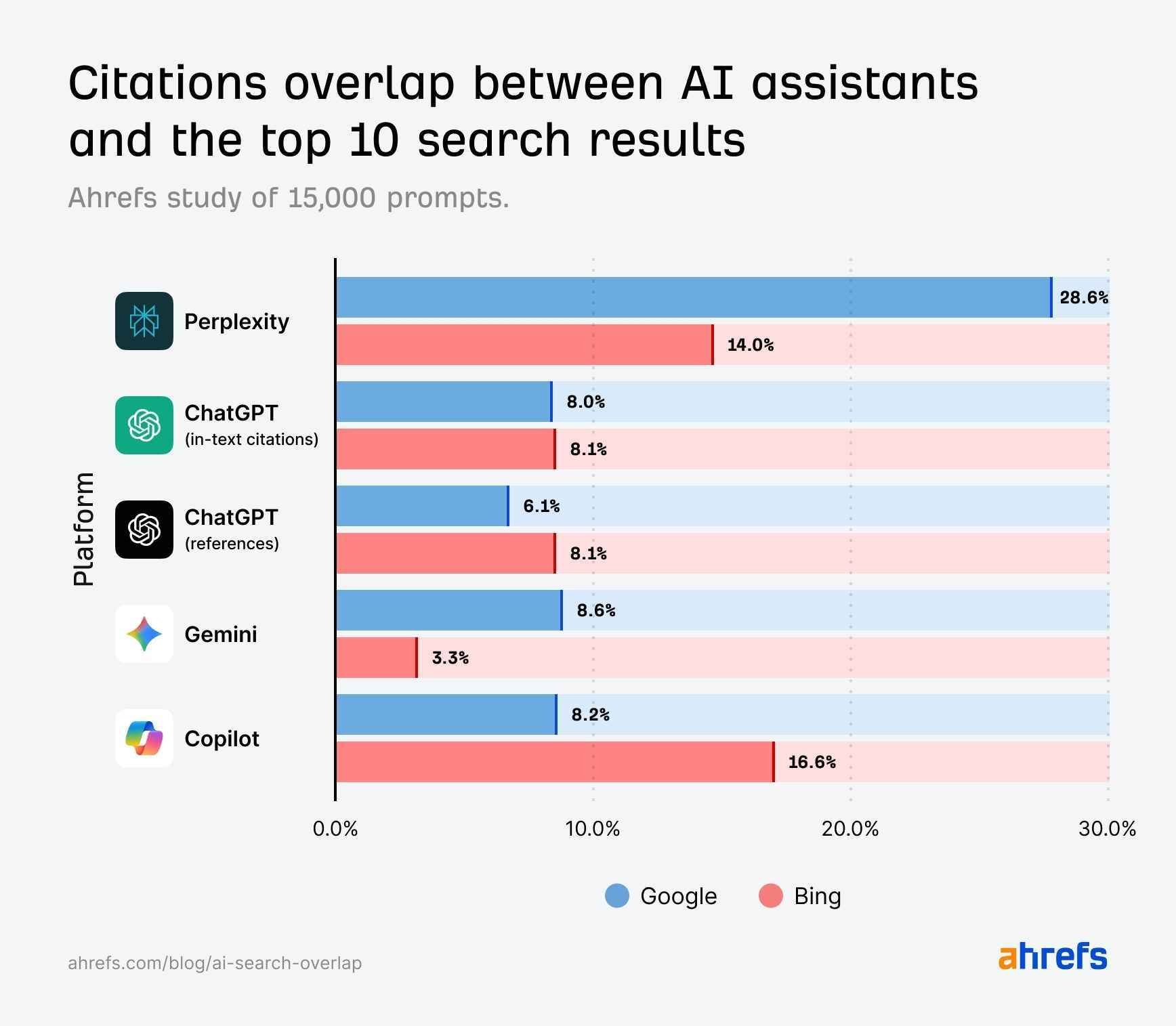
You could be dominating Google's first page for a keyword but be completely invisible in AI search results. Conversely, you might rank poorly in Google but frequently get cited by ChatGPT or Claude. This lack of correlation means you need entirely different measurement approaches.
A SEMrush study found that the average Google query is just 4.2 words long, while the average ChatGPT prompt is 22 words. That's more than five times longer, and it has massive implications for measurement.
With Google's short queries, you could track a handful of target keywords and have a good sense of your visibility. But with 22-word prompts, the chances of multiple users typing the exact same query are vanishingly small.
When people use Google, they think in keywords, short, stripped-down queries. With AI search, users provide context, describe their situation, and have a conversation rather than performing a search. This behavioural shift requires a completely new measurement framework.
Google exposes search volume data through their API, which is why tools like SEMrush can show you exactly how many people search for specific terms. With AI search, this data simply isn't available.
The key differences:
Traditional SEO:
AEO:
This variability makes measurement more complex than simply checking where you rank for a keyword.
Creating your prompt variants is only half the battle. You need a way to actually measure your visibility across different AI platforms.
Several options exist in the market. At Blend, as part of our AEO services, we've partnered with Scrunch after evaluating multiple tools. It offers tracking across ten different large language models with excellent data visualisation and flexibility to manage numerous prompts across different categories.
Modern AEO measurement tools provide several layers of visibility. At the dashboard level, you get an overview of your overall performance - your competitive presence compared to rivals, which AI platforms cite you most frequently, the sentiment when your brand is mentioned, and whether you're typically cited at the top, middle, or bottom of answers.
.jpg?width=4160&height=2660&name=AEO%20measurement%202%20(1).jpg)
The real value comes at the individual prompt level. For each prompt variant you're tracking, you can see a timeline of whether you appeared in the answer, whether you were cited, and which specific pages from your site were referenced.
Taking a specific example, if you're tracking a prompt like "B2B SaaS HubSpot website agency", you'll see a timeline showing when you appeared in results and when you didn't. You might see a pattern where you weren't present for several days, then suddenly started appearing consistently after making technical changes to your site or publishing new content.
.jpg?width=1265&height=912&name=Scrunch%20individual%20prompt%20(1).jpg)
The visualisation uses simple colour-coding. Green indicates you were present and cited, red means you weren't present. When you see more green than red appearing after optimisations, that's your signal you're moving in the right direction.
Here's something crucial to understand: you will not appear in every single response for a given prompt. Even if you've done everything right, you'll still see some red circles mixed in with the green. That's completely normal with large language models.
What you're looking for is directional trends. Are you seeing more green over time? When you make improvements, does the ratio shift in your favour? Are you being cited from a variety of your pages?
Pay attention to which specific pages are being cited. If content you created for a specific category starts appearing in citations, that's validation your strategy is working.
Whilst prompt visibility tracking is crucial, it's not the only metric you should monitor. We recommend a four-layer measurement framework.
This is your earliest signal of success. Are you becoming more visible across the prompt categories you care about? This should be your leading indicator, the first thing that moves when your AEO strategy is working.
After establishing visibility, you should expect to see increased referral traffic from AI platforms. Look in your analytics for traffic from ChatGPT, Claude, Perplexity, and Gemini.
Set proper expectations here. AI referral traffic likely won't match organic search volume yet. Users might see your brand mentioned, get information from the AI's summary, and then navigate to you through a different channel.
When someone discovers you through AI search, they often don't immediately click through. Instead, they might search for your brand in Google or type your URL directly.
Track whether you're seeing lift in:
This captures AI-driven discovery that isn't properly attributed through standard tracking.
Add questions to your high-intent conversion forms asking how prospects discovered your company. Are people mentioning ChatGPT, AI search, or similar terms?
Also track your commercial signals:
Even if you can't draw a direct line from AI visibility to conversions through analytics, the correlation matters.
Whilst we've focused on measurement, AEO isn't just about content. Technical optimisation plays a crucial role in whether AI systems can effectively crawl, understand, and cite your site.
Proper schema markup helps AI systems understand your content structure and context. A clear site architecture makes it easier for large language models to navigate and extract relevant information. Fast page speeds ensure AI crawlers can efficiently access your content, whilst machine-readable formatting allows AI systems to parse and process your information accurately.
Many technical SEO best practices help with AEO too, but there are additional considerations specific to how large language models process information. The good news? When you make technical improvements, you can often see relatively quick improvements in your prompt visibility metrics within a week or two.
AEO measurement represents a fundamental shift from traditional SEO analytics. Success isn't about finding the one perfect prompt to rank for. It's about establishing category-level authority that makes you relevant across a broad range of related queries.
The four-layer measurement framework gives you the structure you need:
If you approach AEO measurement with these principles, using the right tools and frameworks, you'll understand whether your optimisation efforts are working. More importantly, you'll be able to iterate and improve based on real data rather than assumptions.
Learn more about our AEO services and how we can help you get found by your ideal customers.