
.jpg?width=2400&height=1500&name=eCommerce%20on%20HubSpot%20(1).jpg)
Ready to build an eCommerce website that integrates with your marketing operations?
Speak with our team to discuss which approach best suits your business needs and how we can create a seamless eCommerce experience that drives growth.
Here's a question we hear constantly: can you actually do eCommerce on HubSpot? The short answer is yes. The longer answer is that HubSpot offers three distinct approaches to eCommerce, each designed for different business needs. Whether you're selling a handful of products or running a sophisticated B2B catalogue with complex configurations, there's likely a solution that works.The key is understanding which approach fits your business model. If you're trying to build a massive B2C marketplace, HubSpot probably isn't your platform. But for B2B companies that want seamless eCommerce integrated with their existing marketing and sales operations, HubSpot can be surprisingly powerful.
When discussing eCommerce on HubSpot, the conversation often starts with limitations. That's understandable. HubSpot isn't trying to compete with Shopify or Magento for massive consumer marketplaces. However, the concerns we hear about HubSpot's eCommerce capabilities don't always match the reality of what's possible.
For B2B companies already using HubSpot for their website, CRM, and marketing operations, adding eCommerce functionality can be remarkably straightforward. The platform provides three distinct approaches, each with different capabilities and ideal use cases. Understanding these options helps you choose the right solution without overcomplicating your tech stack.
Commerce Hub brings eCommerce functionality directly into HubSpot without requiring external platforms. You build product catalogues, create payment links, and process purchases using HubSpot Payments or Stripe. The platform handles subscription billing through recurring line items and generates quotes for B2B sales processes. QuickBooks integration keeps accounting data synchronised, and consumption-based pricing means you only pay for actual transactions.

This approach works well when you have a focused product range and want everything managed within HubSpot. It's particularly effective for:
The limitation is that each payment link corresponds to a specific product at a fixed price. You can't offer colour variations, size options, or custom configurations within Commerce Hub itself, making it better suited for straightforward product catalogues.
Most HubSpot users integrate a dedicated eCommerce platform with their HubSpot website. Shopify is the go-to option for B2B companies, providing robust commerce capabilities without enterprise-level complexity.
The integration works by building your eCommerce experience on the third-party platform whilst maintaining visual consistency with your HubSpot website. When implemented properly, customers experience a seamless journey without realising they've moved between platforms.
What makes this approach particularly powerful is the data connection. Product information, customer records, purchase history, and browsing behaviour all sync back into HubSpot. Your marketing team continues working in HubSpot, your eCommerce platform handles shopping, and everything connects through integration. This eliminates the fragmentation that comes from managing separate platforms.
We've developed multiple HubSpot websites using this hybrid approach:
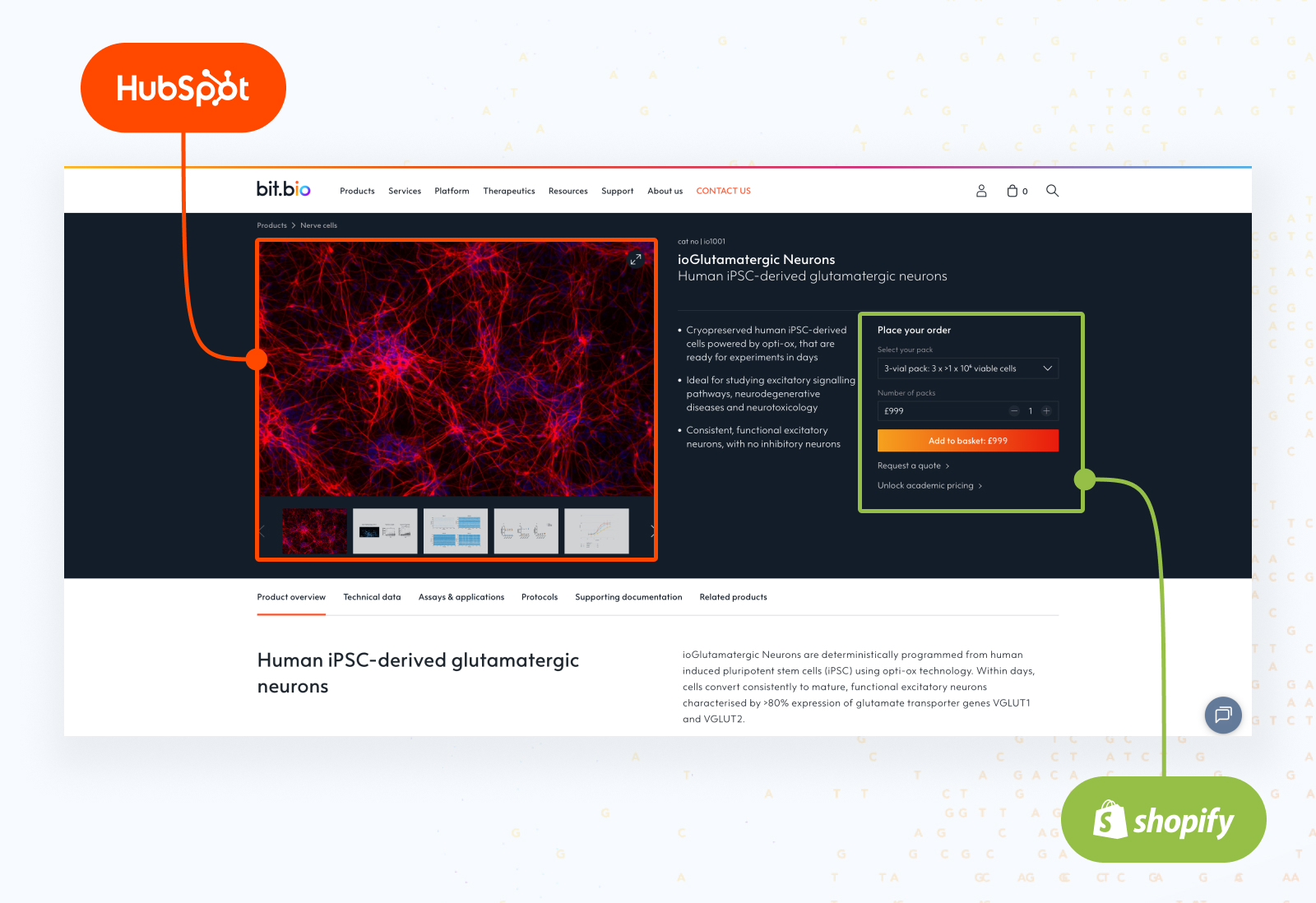
Custom HubSpot development builds eCommerce functionality directly into HubSpot without relying on external platforms. You store product data in HubSpot (often using HubDB for structured product information), build shopping cart functionality in the browser using cookies, and integrate directly with payment processors like Stripe. The entire user experience happens within your HubSpot website.
This offers maximum flexibility because you're not constrained by Commerce Hub's limitations or bound by what third-party platforms offer. You can build:
The trade-off is development expertise and ongoing maintenance. Unlike software platforms that receive automatic updates and new features, custom-built solutions require technical partners who can build, troubleshoot, and evolve the system over time. You'll need either in-house developers who understand HubSpot's architecture or a HubSpot partner relationship for long-term support.
If you're already using HubSpot for your CRM, marketing, or sales operations, keeping your eCommerce data connected to that ecosystem becomes incredibly valuable. The alternative, managing eCommerce in a completely separate system, creates data silos that make it harder to understand customer behaviour and harder to execute sophisticated marketing campaigns.
A properly integrated eCommerce solution means product purchases, browsing behaviour, and shopping patterns all feed into HubSpot. Your marketing team can build workflows based on purchase history, abandoned cart behaviour, and product interests. Sales teams see complete customer timelines that include both website interactions and purchase activity. Instead of logging into multiple systems to understand customer behaviour, everything lives in HubSpot as your single source of truth.
The automation possibilities become particularly powerful when your eCommerce data lives in HubSpot:
All of this happens within the platform your team already uses daily, eliminating the learning curve and workflow friction that comes with managing separate systems.
HubSpot excels at eCommerce when you're already embedded in the HubSpot ecosystem. If your marketing team works in HubSpot daily, your sales process runs through HubSpot CRM, and your website exists on HubSpot Content Hub, adding eCommerce creates operational efficiency rather than additional complexity.
B2B companies with moderate product catalogues tend to see the most success. The platform works particularly well when eCommerce supports your business model rather than serving as your entire business model.
Quote-driven businesses find particular value because they can create eCommerce-style browsing experiences without forcing immediate checkout. Customers explore products with detailed specifications, build their selections, and request formal quotes. This maintains the consultative B2B sales process whilst eliminating manual back-and-forth for product information.
HubSpot isn't the right eCommerce solution for every business. High-volume operations with thousands of products, complex inventory management requirements, and sophisticated fulfilment needs will outgrow what HubSpot offers. The platform simply wasn't designed for consumer marketplaces that need advanced features like real-time inventory across dozens of warehouses or complex shipping calculations based on weight, dimensions, and destination.
If eCommerce is your primary business model rather than a supporting channel, dedicated eCommerce platforms provide more robust features. You'll get better inventory management across multiple locations, more payment gateway options, advanced shipping integrations with multiple carriers, and eCommerce-specific marketing tools that don't exist in HubSpot. These platforms are built specifically for commerce and receive constant feature updates focused on that use case.
To maximise HubSpot's eCommerce potential, focus on both technical and strategic elements of your implementation.
Start with a streamlined theme, either chosen from the marketplace or custom-built for your brand. This ensures your website's codebase remains efficient and performant. If you opt for the custom-theme route, work with an accredited and experienced HubSpot website designer who understands how to create websites that are both visually impactful and technically optimised for performance.
Pay particular attention to image optimisation across your product catalogue. Large, unoptimised images are one of the most common performance issues we see. Use appropriate file formats, compress images without sacrificing quality, and implement lazy loading for product galleries.
Develop a clear strategy that outlines your goals, target keywords for product discovery, and content approach. Use HubSpot's built-in tools consistently to maintain SEO performance and track results. The platform's analytics capabilities help you understand which products generate interest, where customers drop off in the purchase journey, and which marketing channels drive the most valuable traffic.
Consider how your eCommerce experience integrates with your broader marketing efforts:
When all of these elements work together within HubSpot, you create a cohesive customer experience that feels intentional rather than fragmented.
The websites we've built demonstrate that eCommerce on HubSpot can be sophisticated, user-friendly, and genuinely effective for B2B operations. The key is choosing the right approach for your specific needs and ensuring proper integration between platforms.
Commerce Hub provides simplicity for straightforward product sales. Third-party integrations deliver robust eCommerce functionality whilst maintaining data connectivity. Custom development offers complete flexibility when you have specific requirements that standard solutions can't address.
Whichever approach you choose, the goal remains the same: creating a seamless experience for your customers whilst keeping all your business data connected in one place. When implemented properly, eCommerce on HubSpot becomes a natural extension of your marketing and sales operations rather than a bolt-on solution that creates more complexity.
Speak with our team to discuss which approach best suits your business needs and how we can create a seamless eCommerce experience that drives growth.