
Ready to build a website that drives real growth?
Speak with our team to discover how we can help transform your website into a powerful conversion engine.
Life science companies face a unique challenge. Your buyers aren't impulse purchasers. They're researchers, clinicians, and lab managers who need detailed evidence before making decisions. They're comparing multiple vendors, evaluating scientific validity, and justifying purchases to committees. Your website needs to serve all these audiences without overwhelming any of them.
Most agencies build life science websites that fall into two traps. They build sites that lack the depth your technical audience requires, or they create pages that overwhelm visitors with complexity. Neither approach works when your buyers need both scientific rigour and clear commercial guidance.
This article identifies the eight best web design agencies that understand life science buying behaviour. We've evaluated each based on industry experience, technical capabilities, and proven results delivering websites that generate qualified leads for life science companies.
|
Agency |
Location |
Best For |
Starting Investment |
Notable Clients |
|---|---|---|---|---|
|
UK & USA |
Outcome-focused websites that convert technical buyers |
From £30k |
Labguru, Biocair, Viedoc |
|
|
USA |
eCommerce capabilities and platform flexibility |
Contact for pricing |
iQ Biosciences, Multerra Bio |
|
|
USA |
Enterprise solutions with extensive team resources |
Contact for pricing |
Global DWK, pharmaceutical companies |
|
|
USA |
Multi-audience website experiences |
Contact for pricing |
Upsher-Smith, medical device manufacturers |
|
|
USA |
Lead generation focused design |
Contact for pricing |
Biotech and life science startups |
|
|
USA |
Fast turnaround for early-stage companies |
Contact for pricing |
Early-stage biopharma and biotech |
|
|
USA |
Boston-based biotech specialists |
Contact for pricing |
Treventis, Vetigenics, biotech startups |
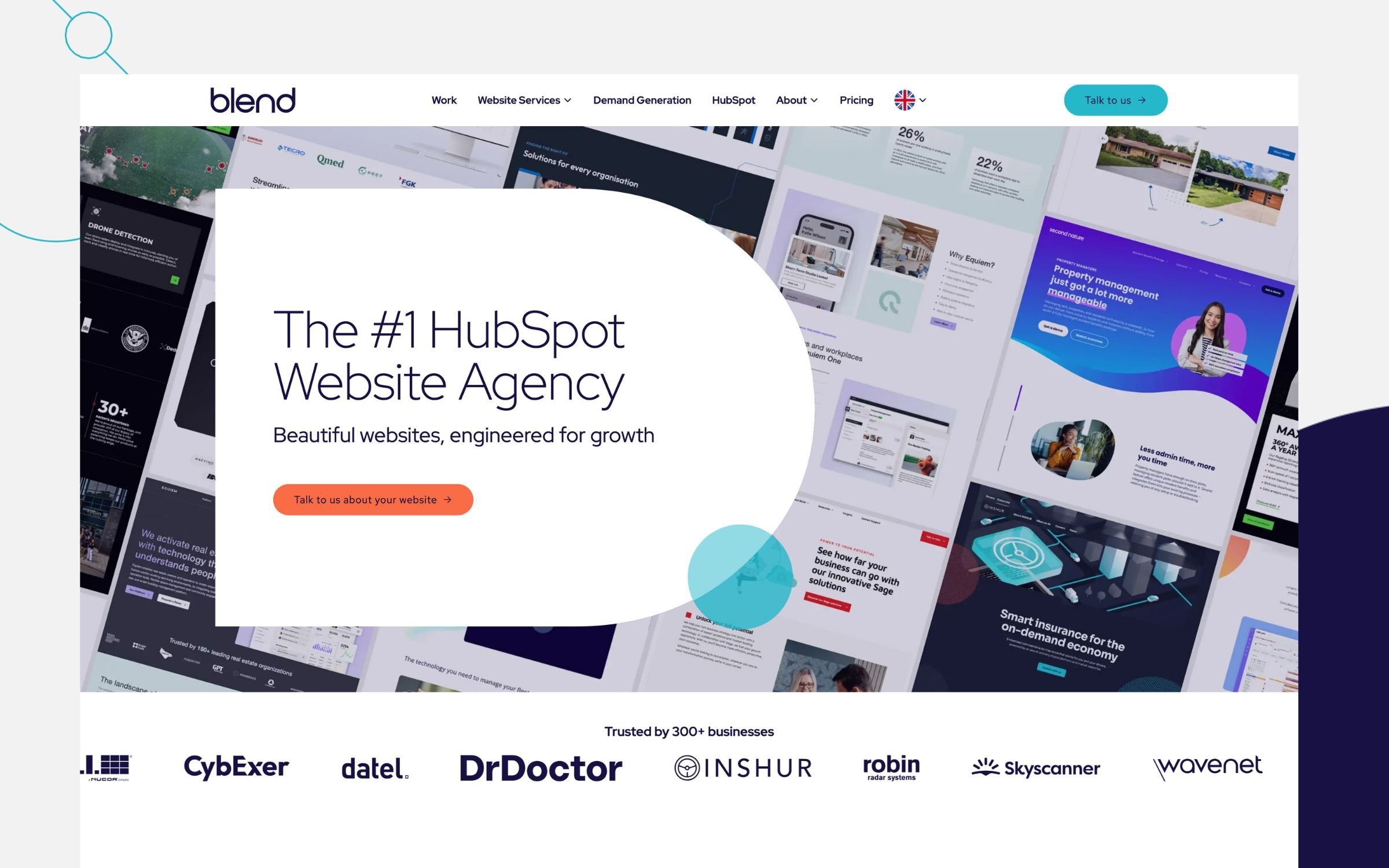
Blend builds websites for life science companies that balance scientific credibility with commercial performance.
What makes Blend the best choice for life science companies:
Life science buyers spend months evaluating solutions before they ever contact sales. Blend builds websites that support this research process with clear information architecture, making technical specifications and validation data easily accessible without overwhelming commercial messaging.
Blend combines creative design that reflects scientific rigour with flexible, easy-to-edit systems that let teams update research findings, add new studies, or launch products without developer involvement. Every website converts technical audiences by communicating complex science clearly while maintaining the precision credibility depends on.
Proven results for life science companies:
Digital Elevator is a Pennsylvania-based agency specializing in life science and biotech web design. They work with biotechnology and pharmaceutical companies to create sophisticated websites with strong eCommerce capabilities. Their expertise spans multiple platforms including WordPress, Shopify, Webflow, and Adobe Commerce Cloud, making them particularly valuable for companies with complex technical requirements or product catalogues. With over 400 completed projects, they combine UX design with strategic information architecture to deliver websites that convert technical audiences.
Supreme Optimization is a premium web agency with a team of 50+ programmers specializing in life science marketing websites. They work with both startups and large enterprises, offering solutions from cost-effective content management systems like WordPress to enterprise platforms like Sitecore. Their team includes Ph.D. scientist-marketers who understand complex scientific products and customer needs. Supreme has spent over a decade pioneering eCommerce solutions specifically for life science companies, with particular expertise in PIM, ERP, and CRM integrations.
Windmill Strategy is a digital marketing agency specializing in life sciences and biotech website design. They work with medical technology, pharmaceutical, and biotech companies to create websites that serve multiple distinct audiences. Their approach focuses on resonating with healthcare professionals, technicians, investors, scientists, administrators, and patients simultaneously. Windmill combines strategic goal alignment with expert copywriting and SEO to deliver websites optimized for both desktop and mobile devices.
Samba Scientific offers custom biotech and life science website designs optimized for lead generation. Their team combines scientific expertise with design capabilities to create websites that work as sales tools, operating continuously to attract leads and establish industry authority. Samba treats websites as living assets, continuously monitoring performance metrics including keyword rankings, visitor engagement, and lead generation. They focus on helping life science companies reach target audiences while meeting commercial goals.
Stellar Biotech Design is a biotech website design agency focused on early-stage biopharmaceutical and biotech companies. Their team of experienced biotech and pharma designers, writers, developers, and digital marketers specialize in fast, agile delivery of scientifically sound brand messaging. Stellar focuses on crafting nuanced, accurate content for maximum investor and partner engagement. Their services include WordPress web design and development, SEO, social media marketing, and custom scientific illustrations and animations. They've even achieved award-winning websites in as little as four weeks.
Axxiem Web Solutions is a New York-based agency with deep expertise in biotech website design. They work with clients ranging from stealth-mode startups to well-established companies, with the majority of projects focused on biotech web design. Axxiem offers comprehensive services including website strategy and design, responsive development, SEO, custom graphics and animations, and digital marketing. Their team understands the biotech sector and startup needs, providing valuable insights that help life science companies effectively communicate with limited resources. Based near Boston, they're particularly connected to the biotech hub ecosystem.
Life science buyers conduct extensive research before making purchase decisions. They're evaluating scientific validity, comparing methodologies, and assessing whether your solution integrates with existing laboratory workflows. Generic agencies miss these nuances.
Great life science agencies understand that your buyers need access to detailed technical specifications, validation data, and peer-reviewed evidence. They build websites where this information is readily available without cluttering the commercial messaging. The result is a site that serves both the researcher seeking technical depth and the procurement manager seeking commercial clarity.
When agencies lack this understanding, they create sites that either oversimplify the science or overwhelm visitors with jargon. Neither approach converts qualified leads.
Life science products involve complex mechanisms, methodologies, and applications. Your website must communicate this complexity accurately while remaining accessible to multiple audiences. This requires more than good copywriting.
Effective agencies employ scientific writers who understand your research. They can translate technical specifications into clear benefit statements without sacrificing accuracy. They know when to use precise terminology and when to provide context for less technical stakeholders.
This capability extends beyond copy. Visual communication through diagrams, data visualization, and process illustrations helps convey complex information quickly. The best agencies integrate these elements naturally throughout the site architecture.
Life science companies don't convert visitors through aggressive sales tactics. Trust builds through evidence. Your website needs to provide proof points that address technical concerns, commercial viability, and implementation feasibility.
This means strategic placement of case studies, technical documentation, validation data, and customer testimonials. Each piece of evidence should appear at the precise moment when different stakeholders need reassurance. Researchers need technical validation early. Procurement teams need commercial evidence later.
Great agencies structure websites to provide this evidence progressively, matching the natural evaluation process your buyers follow. Poor agencies scatter proof points randomly or gate valuable content behind forms, creating friction exactly when buyers need confidence.
Review each agency's life science portfolio carefully. Look beyond visual appeal to assess whether their previous work demonstrates genuine understanding of scientific communication. Can you identify clear information architecture for technical audiences? Do case studies show measurable improvements in qualified lead generation?
Generic B2B experience doesn't translate directly to life science requirements. You need evidence that an agency has successfully balanced technical depth with commercial clarity for companies similar to yours.
Request writing samples or arrange conversations with the team members who would create your content. They should demonstrate ability to discuss your science without oversimplifying or misrepresenting. Can they explain complex concepts clearly? Do they ask intelligent questions about your methodology?
Poor communication capabilities surface quickly. If an agency struggles to understand your products during the sales process, they'll struggle throughout the project. This leads to endless revision cycles and mediocre results.
Life science companies often need websites that integrate with laboratory information management systems, CRM platforms, and eCommerce functionality. Verify that your chosen agency has experience with these technical requirements on their preferred platform.
Platform choice matters. Some agencies default to familiar tools regardless of client needs. Others make strategic recommendations based on your specific requirements. The best partners explain trade-offs clearly and help you make informed decisions.
Ask for specific examples of how the agency has improved conversion rates for life science clients. Look for data-driven approaches to information architecture, content strategy, and user journey optimization. Agencies should articulate clear hypotheses about what drives conversions in scientific buying contexts.
Aesthetic design matters, but commercial performance matters more. Your website exists to generate qualified opportunities. Choose an agency that prioritizes measurable business outcomes alongside visual excellence.
Life science companies need websites that evolve as you grow. Blend support life science companies from early-stage validation through commercial scale with one unified approach. Start with core commercial pages, then expand into technical documentation and resource libraries without rebuilding foundations.
Blend specializes in creating websites for life science companies, with proven results like Labguru's 132% increase in demo requests and Biocair's 152% growth in qualified leads.
Look for demonstrated experience with scientific communication, proven ability to balance technical depth with commercial clarity, and a portfolio showing measurable results for life science clients. The agency should understand your buyers conduct extensive research before purchasing, requiring websites that serve multiple stakeholder types. Verify they can integrate technical documentation naturally without overwhelming commercial messaging.
Life science website projects typically range from £30,000 to £150,000 depending on scope, complexity, and technical requirements. Simpler brochure sites start around £30,000, while comprehensive platforms with eCommerce, integrations, and extensive content libraries reach £100,000 or more. Most agencies offer custom quotes based on specific requirements. Blend's life science projects start from £30,000, with investment scaling based on technical complexity and content volume.
Most life science websites take three to six months from strategy through launch. Factors affecting timeline include content volume, technical complexity, integration requirements, and internal approval processes. Simple sites can launch in two months with finalized content and streamlined approvals. Complex platforms with extensive technical documentation and multiple integrations typically require four to six months. Stellar Biotech Design has achieved launches in as little as four weeks for focused projects.
Blend's life science clients have achieved significant improvements, with Labguru seeing 132% increase in demo requests and Viedoc doubling their new user to MQL conversion rate from 0.7% to 1.4%. Results depend on current website performance, competitive positioning, and ongoing content strategy. Most companies see improved engagement metrics within the first quarter post-launch, with lead generation improvements building over six to twelve months as organic search rankings improve and technical audiences discover new content.
The agencies listed here share proven experience serving life science companies. They understand the unique challenges of communicating complex science while driving commercial results. Each brings distinct strengths, from eCommerce expertise to enterprise platform capabilities.
Your choice depends on matching agency capabilities to your specific situation. Early-stage companies benefit from agencies experienced with rapid execution and investor-focused messaging. Established companies need partners who can handle complex integrations and extensive content libraries.
Remember, your website represents your scientific credibility to the world. The agency you choose should understand not just web design, but the unique challenges of building trust with technical audiences who require evidence-based decision-making.
We build websites for life science companies where every element serves a commercial purpose. Technical depth without commercial clarity generates interest but few qualified leads. Commercial focus without scientific rigour fails to build trust with your technical buyers.
We've spent over a decade refining our approach to life science websites. We understand that your buyers conduct months of research before contacting sales. They're comparing methodologies, evaluating validation data, and assessing implementation complexity. Your website needs to serve this research process while guiding qualified prospects toward conversion.
Our life science clients have achieved remarkable results. Labguru saw a 132% increase in demo requests and 19% increase in sessions. Biocair generated 152% more qualified leads. Viedoc doubled their new user to MQL conversion rate after launch.
Speak with our team to discover how we can help transform your website into a powerful conversion engine.